Dublin Kitchens


Integrated Fridge Freezer Housing: Match the Appliance Before the Cabinet
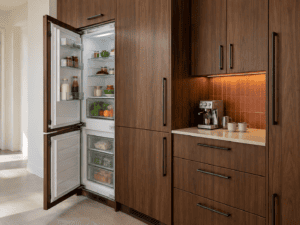
Use this guide when choosing a new integrated fridge-freezer or replacing one inside an existing kitchen. The exact manufacturer’s installation drawing takes priority over any general size guide. For overall tall-unit dimensions, see our cabinet sizes article.
Contents
- Understand the split
- Check door-fixing systems
- Plan ventilation
- Allow full door opening
- Replacement checks
- FAQ
50/50 and 70/30 describe the appliance and front arrangement
The numbers refer broadly to the proportion of refrigerator and freezer space or their door arrangement. The kitchen front has to meet the appliance doors at the correct heights. A 50/50 furniture-door pair is not automatically suitable for a 70/30 machine. Even within one split, the fixing template and hinge system can differ between models.
Kitchens4U lists tall housing examples for 50/50 and 70/30 arrangements. The listing titles show available cabinet configurations, but the exact fridge-freezer model, furniture fronts and cabinet drawing still need to be compared before purchase.
Write the appliance’s model number on the kitchen schedule. Ask the designer to show the upper and lower furniture fronts separately, including hinge side and handle positions. If a top box is planned above the appliance, confirm that it is a separate cabinet item rather than storage space inside the fridge housing.
Sliding or door-on-door fixing?
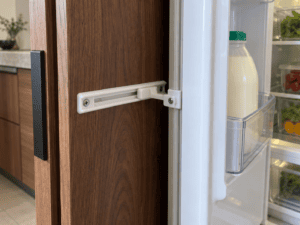
Integrated fridge-freezers generally use a specific method to connect the appliance doors to the furniture fronts. A sliding arrangement and a door-on-door arrangement are not interchangeable by appearance alone. They affect hinges, the movement of the fronts and the parts that need to be supplied. The appliance’s installation sheet identifies the system and any door-panel limits.
If a supplier proposes a different fridge-freezer after the cabinets are ordered, revisit the door-fixing method as well as the height. Do not assume a fitter can simply reposition the old hardware. Extra holes in a finished front can leave a poor result, and a door that is too heavy or too large can strain the mechanism.
For an existing kitchen, photograph the open fridge door, the connection to the furniture panel and the hinge side. Measure the actual opening and furniture fronts before searching for a replacement. This information is more useful than knowing only the brand of the old fridge.
Ventilation is part of the cabinet design
An integrated fridge-freezer needs the air path specified by its manufacturer. That may involve a route at the plinth, behind the appliance and at the top of the housing. The dimensions and openings are model-specific. A cabinet that looks seamless but blocks the required air flow is not a successful installation.
Check the floor, plinth and any top cabinet on the same drawing. Ask where warm air will exit and whether the cabinet backs or shelves need a particular configuration. Do not cover a required grille with a decorative kickboard or store items in a space reserved for ventilation. The installer should also be able to pull the appliance out later for servicing without destroying the fitted kitchen.
Will the refrigerator door open far enough?
At the end of a run, a wall, radiator or projecting handle can stop the fridge door opening. It may appear to clear at 90 degrees yet still prevent internal drawers or shelves from being removed. Check the appliance manufacturer’s door-opening requirement and draw that arc on the plan. A filler or a different hinge side may solve the issue, but both consume room and must be included in the schedule.
Also consider daily use: can someone open the fridge while another person stands at the worktop? Is there a nearby surface for groceries? A tall appliance belongs where it works for the household, not only where it makes an attractive line of doors. The layout guide can help decide its place in the room.
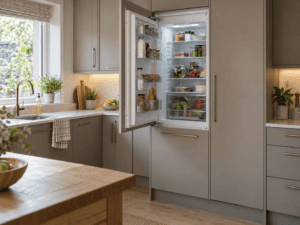
Before replacing an existing integrated appliance
- Record the old appliance model and photograph its fitting arrangement.
- Measure the clear opening and both furniture-door fronts.
- Check the new model’s niche, door split, fixing system and panel limits.
- Confirm the existing ventilation route meets the new instructions.
- Check that the new appliance can be serviced and removed later.
If several points do not match, changing the cabinet or doors may be more reliable than forcing a replacement into the old housing. For a new kitchen, bring the exact appliance drawings to a design consultation before the tall-unit order is final.
Frequently Asked Questions
Can a 70/30 integrated fridge-freezer go in a 50/50 housing?
Do not assume so. The appliance, furniture-door split and fixing system must match the selected cabinet configuration.
Why does an integrated fridge-freezer need ventilation?
The appliance must release heat as specified by its manufacturer. The cabinet and plinth must preserve the required air path.
Can I reuse the kitchen doors when replacing the fridge-freezer?
Sometimes, if their dimensions, weight and fixing system meet the new appliance instructions. Verify before buying.
What if the fridge is next to a wall?
Check the full opening angle needed to remove internal drawers and shelves. A filler or different position may be needed.