Dublin Kitchens

Tall Kitchen Larder Cabinets: Shelves, Internal Drawers or Pull-Out?
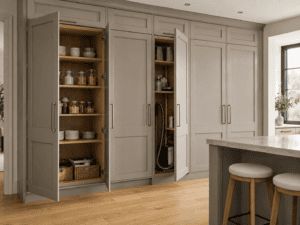
A tall larder uses vertical space well, but “more storage” is not the same as easier storage. A deep cabinet full of fixed shelves can hide food at the back. A full-height pull-out can make every shelf visible but costs more and needs its own clearance. Internal drawers bring items forward while keeping an ordinary hinged door outside. The best choice depends on what you store and who needs to reach it.
This guide is about specifying a tall cabinet, not choosing a whole kitchen style. For the general role of base, wall and tall units, see our kitchen units guide.
Contents
- Position and height
- Compare internal formats
- Plan around contents
- Reach and door clearance
- Specify the order
- FAQ
Start with the tall unit’s position
A larder often works best at the end of a cabinet run, where its full-height side does not interrupt preparation space or block daylight over the worktop. In a small galley kitchen, placing tall units together can create one clear storage wall and keep the opposite worktop open. Where the larder sits beside a fridge, confirm that both doors can open wide enough to access shelves or appliance drawers.
Measure floor-to-ceiling height in several places. A product described as 2150mm high may list carcass height without legs, finishing pieces or installation clearance. Check the actual product drawing, plinth and ceiling details before ordering. An uneven floor is handled by the installation plan, not by assuming the top can be cut off a finished tall cabinet. The cabinet sizes guide explains how to read these dimensions.
Check the wall and fixing conditions too. A loaded tall unit should be level and secured as its manufacturer requires. A shallow service void or boxing behind the cabinet can change the usable depth and the front alignment with the rest of the run.
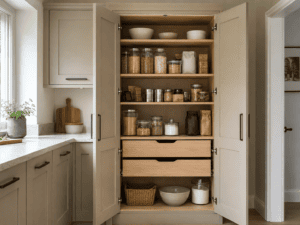
Three ways to organise a tall larder
| Format | Best use | Trade-off |
|---|---|---|
| Adjustable shelves | Large packets, equipment and flexible storage | Items at the back need reaching and organisation |
| Internal drawers | Mixed food storage that should come forward | Open outer door before pulling drawers; check hinge clearance |
| Full-height pull-out | Frequent access to many smaller items | Higher hardware cost, weight limit and exact-fit requirement |
Adjustable shelves are the simplest and most adaptable. They work well if you use bins or trays that can be pulled forward, or if the cupboard holds bulky appliances. Avoid one very tall gap that becomes a stack of precarious packets. Set shelf spacing around your actual containers and allow room to lift an item out.
Internal drawers improve visibility and access without putting heavy items on the highest shelf. Check their clear width, depth and load rating, not just the cabinet’s nominal outside size. The outer door must open far enough for every drawer to extend without hitting the hinge or handle. Some drawer arrangements require a particular hinge opening angle or internal spacer.
A full-height pull-out exposes contents in one movement. It can be very convenient in a narrow cabinet, but it is only as useful as its usable basket dimensions and load rating. A tall mechanism filled with heavy tins is different from one holding cereal and spices. Follow the accessory manufacturer’s fitting and weight specifications, and ask how its runners can be accessed for future servicing.
Make a storage inventory before choosing hardware
Put your current larder contents on a table: food packets, tins, mixing bowls, slow cooker, baking trays and cleaning supplies. Group them by weight and frequency of use. Everyday items belong between roughly waist and shoulder height; very heavy items are usually better low down; rarely used light items can go above. This simple exercise tells you whether shelves, drawers or a pull-out solve an actual problem.
Do not spend on a full-height mechanism if most of the cabinet will hold two bulky appliances. Equally, do not save on hardware and then expect a deep shelf to give quick access to thirty small packets. The best larder often mixes formats: adjustable shelving above and drawers or baskets below, if the chosen cabinet system permits that arrangement.
Check the person and the door, not just the cabinet
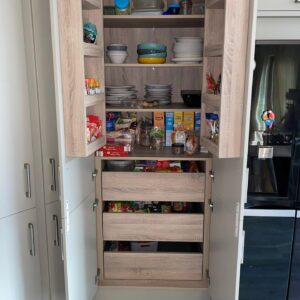
Walk through how the larder will be used. Can a shorter household member see the top shelf? Can someone open the main door while another person passes through the kitchen? Does an island or dining chair obstruct a pull-out? Mark the door arc and the full extension of internal fittings on the plan. A mechanism that clears on an empty showroom floor can be frustrating in a narrow home kitchen.
If the larder is at a wall end, leave sufficient clearance for the door handle and hinge movement. A filler may be required so the door does not strike the wall and internal drawers can open. Also consider whether a tall door should be divided into two fronts for easier handling; confirm what the selected range offers rather than assuming a universal arrangement.
What should appear on the larder quote?
The schedule should identify the carcass, front or fronts, hinge arrangement, number of shelves and every internal drawer or pull-out. Ask whether handles, end panels, plinth, assembly and fitting are included. “Larder cabinet” alone is too broad to compare two quotes fairly.
Browse the flat pack kitchen ranges to see the tall-unit options, or bring a list of what you need to store to a design consultation. That list is more useful than asking for “maximum storage” without explaining what will go in it.
Frequently Asked Questions
Are pull-out larders better than shelves?
They are better for some frequent-access items, but cost more and have specific size and weight limits. Shelves are more flexible for bulky storage.
Can I add internal drawers to a larder later?
Possibly, if the cabinet’s internal dimensions, hinges and fixing points suit the chosen drawer system. Check with the accessory supplier before purchasing.
How high should a tall kitchen cabinet be?
There is no single suitable height for every room. Use the exact product drawing and account for legs, plinth, ceiling, floor variation and installation clearance.
Where should a larder cabinet go?
Often at the end of a run or within a group of tall units, where it does not interrupt worktop space. Check door opening and nearby appliance access.