Dublin Kitchens

Standard Kitchen Cabinet Sizes in Ireland — A Complete Guide to Base, Wall & Tall Unit Dimensions
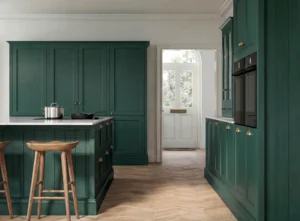
If you’re planning a new kitchen and have started looking at cabinets, you’ve probably noticed something pretty quickly — the numbers all look the same. 300mm, 450mm, 600mm, 1000mm. It’s not random. Kitchen cabinets across Ireland, the UK, and most of Europe follow a standard sizing system that makes planning, manufacturing, and installing them much more straightforward than you’d think.
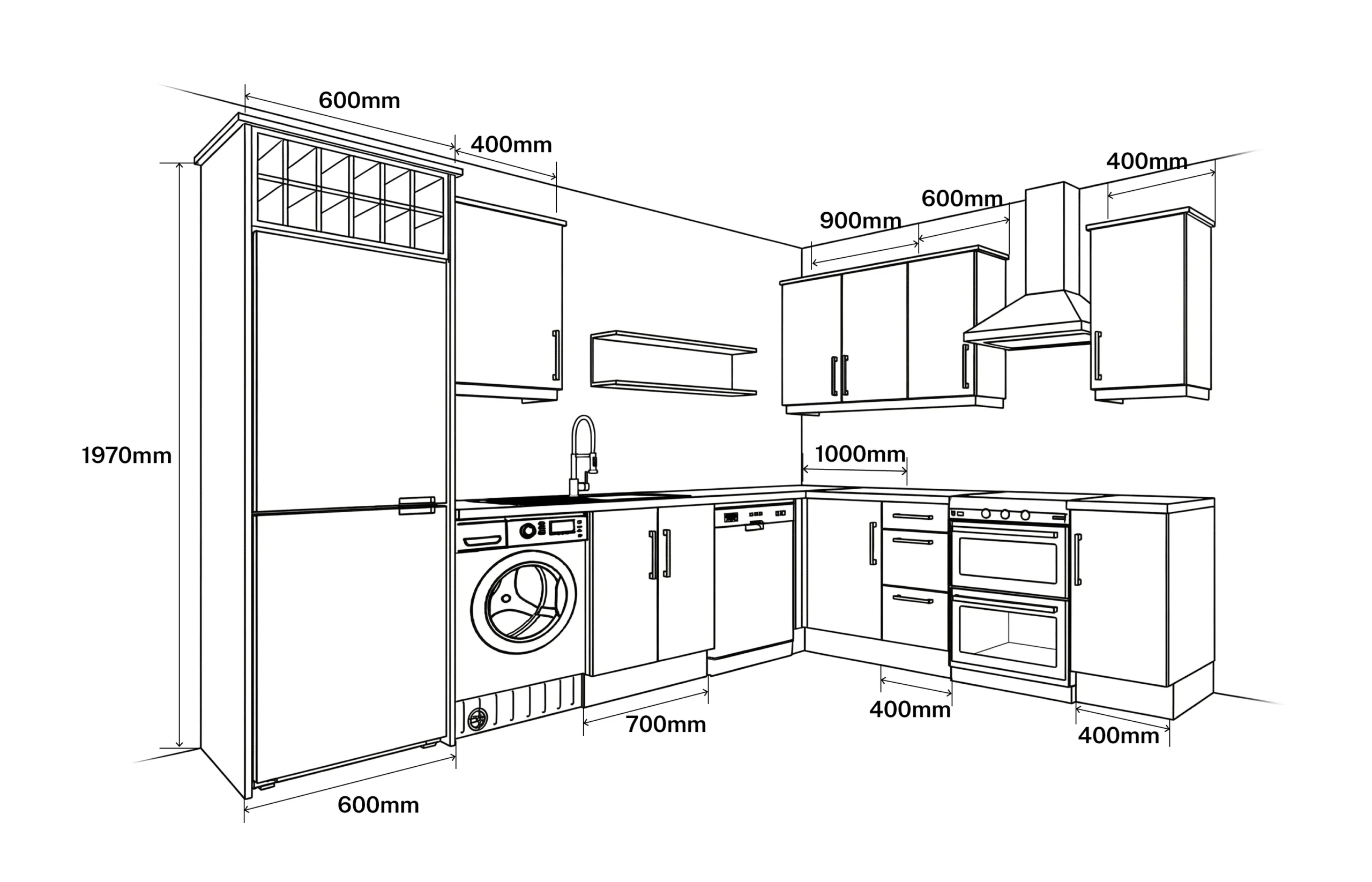
Here’s the short version: nearly all kitchen units come in widths that increase in 50mm or 100mm steps, starting at 150mm and going up to 1200mm. The depth is almost always 570mm for base units. The height for base units (without the worktop) is 720mm, wall units are usually 720mm or 900mm tall, and tall units stretch to 2150mm.
But the short version doesn’t help when you’re standing in your kitchen with a measuring tape, trying to figure out what fits. Let’s go through each type properly.
Why Standard Sizes Exist (And Why They Matter for Irish Homes)
Cabinet sizes are standardised for a practical reason: it keeps costs down and makes replacement parts easy to find. When every manufacturer works to the same dimensions, you can mix cabinets from different ranges and know they’ll line up. If you need a replacement door five years from now, you’re not stuck hunting for something custom-made.
For Irish homes, standard sizing matters even more. Most Dublin properties — whether it’s a Victorian terrace in Rathmines, a 1970s semi-detached in Sandyford, or a modern apartment in the docklands — were built with kitchen footprints that work well with standard unit sizes. You rarely need anything bespoke unless you’re dealing with a particularly awkward corner or a listed building with restrictions.
That said, if your kitchen has unusual angles, sloping ceilings, or you’re converting a space that wasn’t originally a kitchen, you might need to mix in a few custom pieces. We’ll touch on that later.
Base Unit Sizes: The Foundation of Any Kitchen
Base units sit on the floor and carry the worktop. They’re the workhorses of your kitchen — housing everything from pots and pans to integrated appliances.
Standard Base Unit Dimensions
| Unit Width (mm) | Common Use |
| 150mm | Filler panel, narrow pull-out spice rack |
| 300mm | Small storage, bottle rack, narrow drawer unit |
| 400mm | Single drawer unit, compact cupboard |
| 450mm | Compact sink base, small drawer set |
| 500mm | Standard single cupboard or drawer pack |
| 600mm | Most common — general storage, oven housing, dishwasher space |
| 800mm | Large cupboard, double drawer pack, sink unit |
| 900mm | Wide storage, large sink base |
| 1000mm | Extra-wide cupboard, pan drawer set |
| 1200mm | Wide double-door cupboard |
Depth: 570mm is the industry standard for the cabinet carcass itself. Once you add the door front, you’re looking at roughly 590mm. Your worktop will be 600mm deep (sometimes 620mm for extra overhang), which means the door sits flush or slightly recessed under the worktop front edge.
Height: The carcass is 720mm tall. Add your worktop (typically 38mm thick) and the plinth or legs at the bottom (adjustable, usually 120-170mm), and the total finished height of a base unit with worktop comes to about 870-910mm. That’s the standard kitchen worktop height you’ll find in pretty much every Irish home.
How to Calculate What Fits
Measure your available wall-to-wall space in millimetres. Then subtract about 20-30mm at each end for tolerance (walls are rarely perfectly straight). What’s left is the total width of units you can fit.
For example, if you have a 3000mm wall, you’ve got about 2940-2960mm of usable space. That could be:
- 600mm + 600mm + 600mm + 600mm + 500mm = 2900mm (leaves a small filler)
- 1000mm + 600mm + 600mm + 600mm + 100mm filler = 2900mm
- 800mm + 800mm + 600mm + 600mm + 60mm filler = 2860mm
A good kitchen designer will work this out for you — but if you’re planning ahead, this gives you a rough idea of what’s possible.
Wall Unit Sizes: Making the Most of Vertical Space
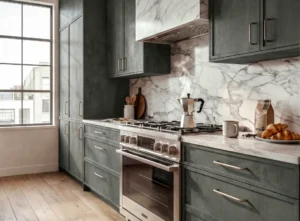
Wall units hang above your worktop and are shallower than base units — typically 330mm deep rather than 570mm. That shallower depth keeps them from hovering over your workspace and making the kitchen feel cramped.
Standard Wall Unit Dimensions
| Width (mm) | Height Options | Common Use |
| 300mm | 720mm or 900mm | Narrow storage, above fridge |
| 400mm | 720mm or 900mm | Compact cupboard |
| 500mm | 720mm or 900mm | Standard single cupboard |
| 600mm | 720mm or 900mm | Most common — general storage |
| 800mm | 720mm or 900mm | Wide storage |
| 900mm | 720mm or 900mm | Extra-wide or double-door |
| 1000mm | 720mm or 900mm | Wide double-door |
| 1200mm | 720mm or 900mm | Wide span, often used above a range |
The 720mm vs 900mm decision: 720mm-tall wall units work well in kitchens with standard ceiling heights. If you’ve got higher ceilings — common in Dublin period properties — 900mm units make better use of the vertical space and give you an extra shelf. Some homeowners mix heights: 720mm above the main run and 900mm on a feature wall or above the fridge.
Positioning: Wall units typically sit 450-500mm above the worktop. That gap gives you enough room to use a kettle, coffee machine, or stand mixer without the cabinets getting in the way.
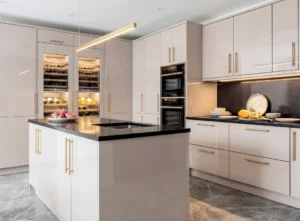
→ Shop Wall Units Now: Phoenix Cashmere High Gloss
Tall Units and Larder Units
Tall units (sometimes called larder units or pantry units) run from floor to nearly ceiling height — 2150mm tall. They’re 570mm deep, same as base units, so they sit flush with the rest of the kitchen.
| Width (mm) | Common Use |
| 300mm | Narrow pull-out pantry, spice rack |
| 400mm | Compact larder with pull-out shelves |
| 500mm | Standard larder, oven housing (single oven) |
| 600mm | Most common — double oven housing, fridge housing, full larder |
Tall units are brilliant for storage but they dominate a kitchen visually. In smaller Dublin kitchens, we usually recommend putting tall units on a single wall or in a corner, so they don’t make the room feel like a corridor.
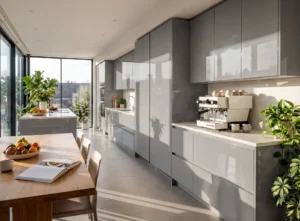
→ Shop Tall Units and Larder Units Now: Phoenix Dust Grey High Gloss Handleless
Corner Units: The Tricky Ones
Corners are where standard sizing meets real-world geometry. There are two main types:
L-shaped corner units: 950mm × 950mm across both walls. These use a special hinged door that opens wide, giving access to the full corner space. Inside, you’ll typically find a carousel or swing-out shelf system — without it, the back of the corner becomes a black hole for lost Tupperware lids.
Standard corner base: A 1000mm or 1100mm unit with a standard door on one side and a blank panel on the other, designed to sit against the adjacent run of cabinets.
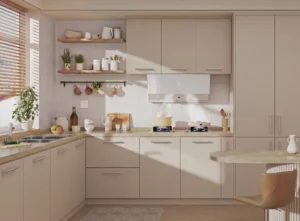
→ Shop Corner Units Now: Galaxy Cashmere Matt Smooth Vinyl
How to Measure Your Kitchen for New Cabinets
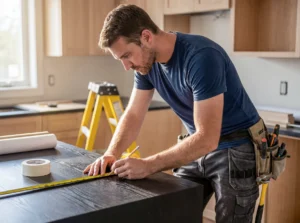
If you’re measuring up yourself before talking to a kitchen supplier, here’s what you need:
- Draw the room shape first. Mark windows, doors, radiators, and any obstacles like boiler flues or structural pillars. Don’t forget to note which way doors swing open.
- Measure each wall in three places — at floor level, worktop height, and ceiling height. Write down the smallest measurement. Old Dublin walls are rarely straight, and the smallest number is the one that actually matters.
- Mark the services. Where are the gas, water, and electrical points? If you’re planning to move the sink or cooker, you’ll need to factor in the cost of relocating services — which can add several hundred euro.
- Measure ceiling height in at least two spots. If you’re planning tall units, you need to know whether 2150mm units will fit without trimming.
- Take photos. Lots of them. From every angle. It’s surprisingly helpful when you’re trying to remember where that odd pipe is.
If any of this sounds like a headache, it’s exactly the sort of thing we do as part of our free design consultation. We come to your home, measure everything properly with professional kit, and build a 3D model so you can see exactly how everything fits.
Book a free design consultation →
Irish Kitchens vs UK Kitchens: Any Differences?
The sizing system in Ireland is the same as the UK and most of Europe. A 600mm base unit in Dublin is the same width as a 600mm base unit in London or Berlin. There are, however, a few practical differences worth knowing:
- Older Irish homesoften have slightly lower ceiling heights than UK equivalents, especially in terraced houses. This can affect tall unit selection — always measure before ordering.
- Irish plumbing conventionsmean sink units sometimes need slightly modified service void spacing behind the cabinet. Our installers deal with this as standard, but it’s worth knowing if you’re ordering online from a UK supplier.
- Metric is universal.You’ll see everything in millimetres. Nobody in the trade uses centimetres for cabinet sizes, and definitely not inches. Get comfortable with millimetres — it’s the only unit that matters in kitchen design.
Frequently Asked Questions
Q: Can I fit standard cabinets into a non-standard Irish kitchen?
A: Most of the time, yes. Standard cabinets cover about 90% of installations. Awkward gaps are filled with filler panels (flat panels cut to width on-site) or pull-out units in custom widths. The only time you genuinely need bespoke cabinets is when a wall angle isn’t 90 degrees or you’re working with a space like an alcove that won’t take any standard width.
Q: What’s the difference between cabinet width and door width?
A: The cabinet carcass is slightly narrower than the door. A 600mm cabinet has a door that’s roughly 595-597mm wide, leaving a small gap (2-3mm) between adjacent doors for them to open without rubbing. This gap is normal and part of the design.
Q: How much gap should I leave between the wall and the cabinet?
A: At least 20mm at each end. This tolerance allows the installer to level the cabinets and fit filler panels if the wall isn’t perfectly straight. They’ll scribe the filler to match the wall contour, so it looks seamless when finished.
Q: Are flat pack cabinet sizes the same as fitted cabinet sizes?
A: Yes — they use the identical sizing system. The difference is in how they arrive (flat-packed for self-assembly vs pre-built), not in the dimensions. A 600mm flat pack base unit is dimensionally identical to a 600mm fitted base unit. This is why you can sometimes mix and match — use fitted for visible areas and flat pack inside a pantry, for example.
Need Help With Your Kitchen Measurements?
Getting the sizes right from the start saves time, money, and the sinking feeling of a cabinet that doesn’t fit. At Kitchens4U, we handle the measuring as part of our free design consultation — we come to your Dublin home, measure everything with professional equipment, and create a 3D design showing exactly how each unit fits your space.
📅 Book a Free Design Consultation →
While you’re planning, you might also find these useful: