Dublin Kitchens

Kitchen Layout Planning for Irish Homes — U-Shape, L-Shape, Galley & Open-Plan
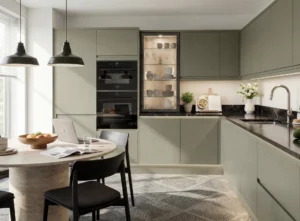
The layout you choose for your kitchen dictates everything else. Cabinet sizes. Worktop lengths. Where the sink goes relative to the hob. Whether you can fit an island. Whether two people can cook at the same time without constantly stepping around each other.
Get the layout right, and the rest falls into place. Get it wrong, and you’ll spend years navigating a kitchen that just doesn’t flow properly — and there’s no easy fix once the plumbing and electrics are in.
Most Irish kitchens fall into one of five layouts. Each one has strengths and weaknesses, and the right one depends on the shape of your room as much as your personal preferences.
The Five Kitchen Layouts
1. Galley Kitchen
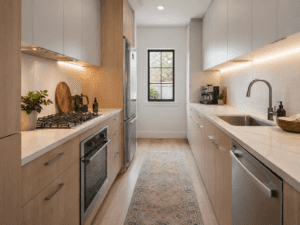
A galley kitchen runs cabinets along two parallel walls, with a walkway between them. It’s the default layout for narrow spaces — Victorian terraces, apartment kitchens, anywhere where the room is longer than it is wide.
Why it works: Maximum efficiency. Every centimetre of both walls is usable, and there’s no wasted corner. The sink and hob usually sit on opposite sides, giving you a natural back-and-forth flow that cooks instinctively understand.
The numbers that matter: The walkway needs to be at least 1000mm wide. 1200mm is better — it lets two people pass each other and means the dishwasher and oven doors can open fully without blocking the path. The two cabinet runs should ideally be at least 2400mm long each. Shorter than that and you start running out of storage.
Watch out for: Doors and windows. A galley with a door halfway down one wall loses cabinet space on that wall. The solution is to put tall units opposite the door and keep the door-wall to base units and open shelving.
Works well in: Dublin Victorian terraces, apartment kitchens, narrow extensions.
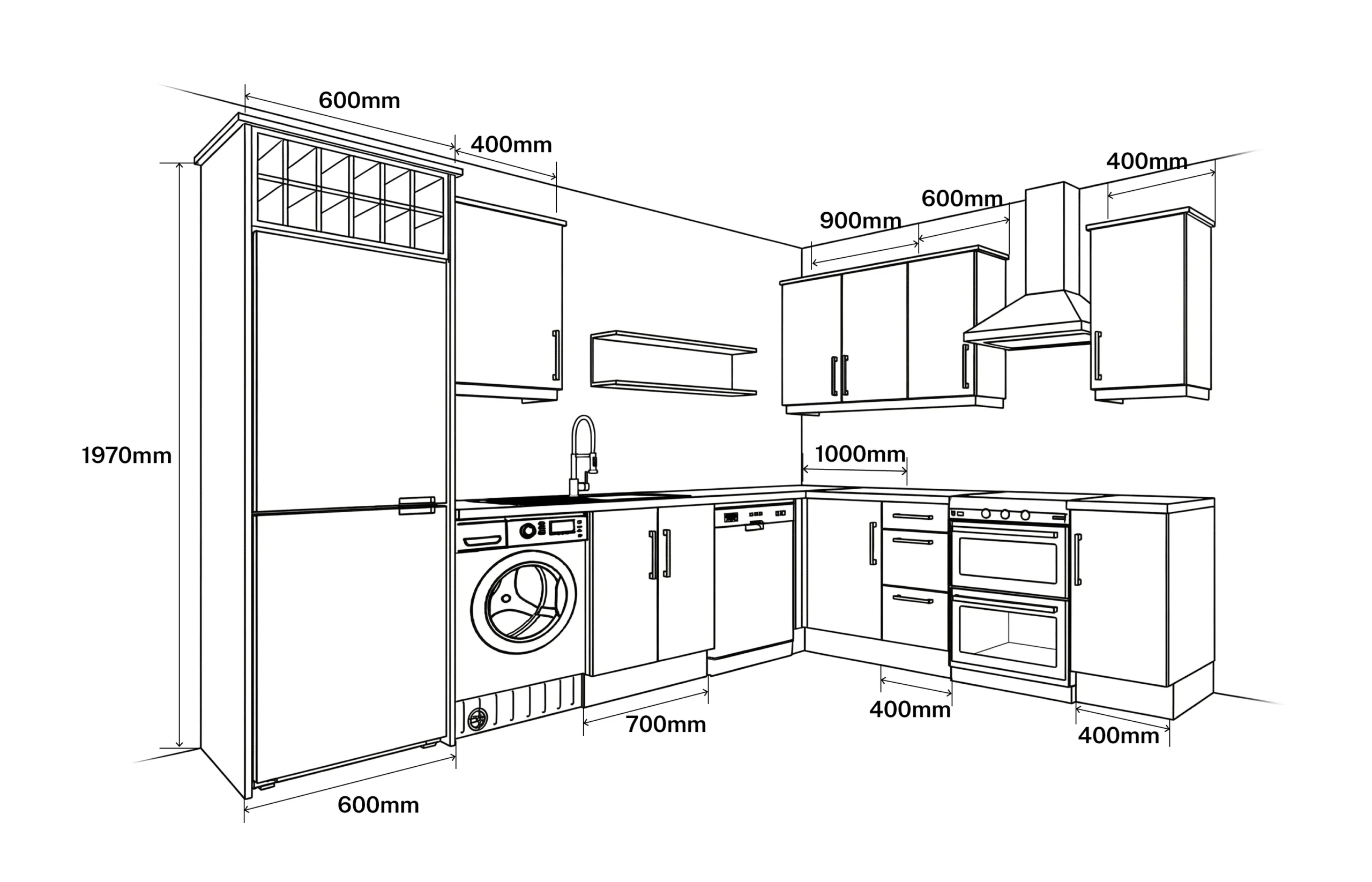
2. L-Shape Kitchen
Cabinets on two adjacent walls, forming an L. The third and fourth walls of the room are either open (to a dining or living area) or used for a table, breakfast bar, or island.
Why it works: Versatility. The L-shape fits into corners beautifully and leaves the rest of the room open. It works in square rooms, rectangular rooms, and open-plan spaces. The corner itself can be a carousel unit or an cleverly-designed blind corner — either way, it earns its keep.
The numbers that matter: Each leg of the L should be at least 1800mm long to give you a proper run of cabinets. The sink typically goes on one leg, the hob on the other, with prep space between them. Legs longer than 3000mm start to feel like a corridor, at which point you should consider a U-shape instead.
Watch out for: The corner. Without a carousel or pull-out system, the back of an L-shaped corner is a dead zone. Budget for proper corner storage hardware — it’s not optional. See corner storage options →
Works well in: Square kitchens, open-plan kitchen-diners, medium-sized family kitchens.
See a real white grey L-shaped kitchen renovation in Raheny →
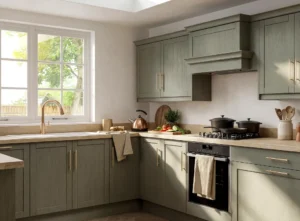
→ Shop Now: Basel Legno Reed Green Matt Vinyl
3. U-Shape Kitchen
Cabinets on three walls, forming a U. The most storage-intensive layout, and often the best use of space in a medium-to-large kitchen.
Why it works: Storage, storage, storage. Three walls of cabinets means you can spread things out — cooking zone on one wall, prep on another, cleaning on the third. Two people can cook simultaneously without getting in each other’s way.
The numbers that matter: The room needs to be at least 2400mm wide to accommodate two runs of 570mm-deep cabinets and a 1000mm walkway. Ideally you want 2700mm or more. Each leg of the U should be at least 1500mm. One leg is often shorter than the others, which is fine — that’s where the tall units go.
Watch out for: The feeling of being boxed in. A U-shape with wall cabinets on all three walls can feel oppressive. Consider leaving one wall free of wall cabinets, or using open shelving instead, to keep the room feeling airy.
Works well in: Larger semi-detached kitchens, country homes, any kitchen where storage is the priority.
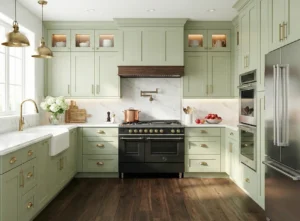
→ Shop Now: Hillwell Meadow Green Superior Matt Vinyl
4. Single-Wall Kitchen
All cabinets on one wall. The simplest layout, and the only option in studios, open-plan apartments, and kitchenettes.
Why it works: It doesn’t dominate the room. In an open-plan living space, a single-wall kitchen sits quietly against one wall and leaves the rest of the space for living, dining, and everything else. It’s also the cheapest layout — least cabinets, least worktop, least labour.
The numbers that matter: The wall needs to be at least 2400mm long to fit a meaningful kitchen. At 3000mm, you can include a decent run of cabinets plus tall units at one or both ends. Wall units above the full run are essential — you need that vertical storage because there’s only one wall to work with.
Watch out for: Running out of worktop space. With only one run, your prep area, cooking zone, and washing-up area all compete for the same surface. An island or peninsula on castors helps enormously, and an under-mounted sink with a flush cover gives you extra worktop when you need it.
Works well in: Studio apartments, open-plan living spaces, kitchenettes, secondary kitchens.
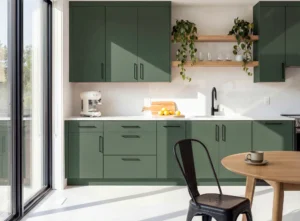
→ Shop Now: Tribeca Heritage Green Superior Matt
5. Open-Plan Kitchen with Island
This is the layout most people dream about: cabinets on one or two walls, an island in the middle, and the whole space flowing into a dining and living area.
Why it works: The island is the centrepiece. It gives you extra storage, more worktop space, a casual dining spot, and a natural gathering point. The kitchen becomes part of the living space rather than a separate service room.
The numbers that matter: The room needs to be large — at least 4000mm × 4000mm to do an island properly. You need at least 1000mm clearance all around the island (1200mm is better, especially if there are cabinets or appliances opening into the walkway). The island itself should be at least 1200mm × 900mm to be useful; smaller than that and it’s a token gesture rather than a working feature.
Watch out for: Services. If you want a sink or hob in the island — and most people do — you need to run plumbing, gas, and electrics under the floor. That means taking up part of the floor, which adds cost and time. It’s worth it, but budget for it upfront.
Works well in: Large open-plan extensions, modern builds, any home where the kitchen is the heart of the house.
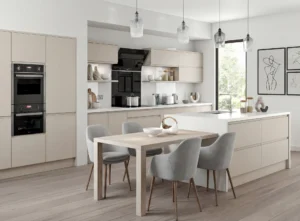
→ Shop Now: Alaska Cashmere Superior Matt Vinyl
The Kitchen Work Triangle
The “work triangle” is the most useful concept in kitchen design, and it’s been around since the 1940s for good reason. It’s simple: the three main work points in any kitchen — sink, hob, and fridge — should form a triangle, and the total distance around that triangle should be between 4000mm and 6600mm.
Less than 4000mm, and you’re cramped. More than 6600mm, and you’re walking marathons between the fridge and the hob. Neither is ideal.
The triangle works differently in each layout:
- Galley: Sink on one wall, hob and fridge on the other. Natural, efficient, small triangle.
- L-Shape: Sink on one leg, hob on the other, fridge at the end of one run. Classic arrangement.
- U-Shape: Sink in the middle of one wall, hob opposite, fridge at one end. The most efficient triangle.
- Single-wall: The triangle collapses into a line. Compensate by putting the sink between the hob and fridge to minimise steps.
- Island: Sink or hob in the island, the other on the wall run, fridge at one end. The triangle opens up and the island becomes a natural pivot point.
Which Layout for Which Dublin Home?
| Home Type | Best Layout | Why |
| Victorian terrace | Galley or L-Shape | Narrow rooms favour galleys; knocked-through kitchens work as L-shapes |
| 1930s-1970s semi-D | L-Shape or U-Shape | Typically have a dedicated kitchen room that works well with two or three walls |
| Modern apartment | Single-wall or Galley | Space is tight; single-wall for open-plan, galley for separate kitchens |
| New build / Large extension | Open-plan with Island | If the space allows, this is the gold standard |
| Georgian / period home | U-Shape or L-Shape with island | Larger rooms allow for more ambitious layouts |
Mistakes We See Repeatedly
Forcing an island into a space that’s too small. An island with 800mm clearance on each side isn’t an island — it’s an obstacle. If the numbers don’t work, consider a peninsula (attached to one wall) or a slim breakfast bar instead.
Ignoring bin placement. Every kitchen needs a bin, and nobody wants it on display. Plan for a pull-out bin unit from the start — retrofitting one in is far harder than including it in the original layout.
Putting the hob right next to a wall or tall unit. You need at least 300mm of worktop on each side of the hob — ideally 400mm or more. This gives you somewhere to put a spoon rest, a pan lid, or a hot tray. A hob jammed against a wall is uncomfortable and, in some cases, a fire risk.
Not enough worktop between sink and hob. This is the main prep zone. You want at least 600mm between the sink and the hob — 900mm is ideal. Less than that and you’ll be prepping ingredients in cramped conditions every single day.
Forgetting about appliance doors. A dishwasher door is about 600mm deep when open. An oven door projects about 500mm. Make sure these can open fully without blocking the walkway or hitting an opposite cabinet. It sounds obvious until you’re stepping over an open dishwasher to get to the fridge.
How Kitchens4U Designs Your Layout
We use 3D design software that models your kitchen in full before anything is ordered. You see the layout from every angle, walk through it virtually, and adjust anything that doesn’t feel right. It takes the guesswork out — you’re not trying to visualise from a 2D floor plan, you’re seeing your actual kitchen in three dimensions.
As part of our free consultation, we visit your home, take precise measurements, and build the 3D model based on your space and your requirements. By the time you approve the design, you’ve already seen exactly how your kitchen will work.
📅 Book a Free Design Consultation →
Frequently Asked Questions
Q: Can I change my kitchen layout without moving the plumbing?
A: Yes, as long as the sink stays in roughly the same position. Moving a sink to the opposite wall means running new pipework, which involves taking up part of the floor or running pipes through ceiling voids. It’s possible, but it adds cost. If you’re on a tight budget, design your layout around the existing sink position.
Q: How do I plan a kitchen for two cooks?
A: Separate the prep zone from the cooking zone. Two people can share a kitchen if one person’s working at the hob and the other’s prepping on a separate section of worktop — ideally with the sink between them. An island or peninsula makes two-cook kitchens dramatically better because it doubles the accessible worktop area.
Q: Should wall cabinets line up with base cabinets?
A: Not necessarily. Wall cabinets above a 600mm base unit don’t have to be 600mm wide — a 400mm or 500mm wall cabinet often looks better because it creates some negative space. Lining everything up perfectly can look rigid and institutional. A bit of asymmetry — within reason — feels more natural.
Q: Can an open-plan kitchen ever be too open?
A: Yes. Noise travels, cooking smells travel, and the mess from cooking is visible from the sofa. The solution is usually partial separation — a half-wall, a breakfast bar with a raised section, or tall units acting as a visual divider. You want the kitchen to feel connected to the living space, not like you’re cooking in the living room.
Get Your Kitchen Designed in 3D
Every kitchen we do starts with a proper 3D design. It’s the only way to be certain the layout works before you commit. And it’s completely free.
📅 Book a Free Design Consultation →
Getting your layout right is the first step. Next: work out your kitchen cabinet sizes → and renovation costs →