Dublin Kitchens

The Hidden Costs of a Kitchen Renovation in Ireland
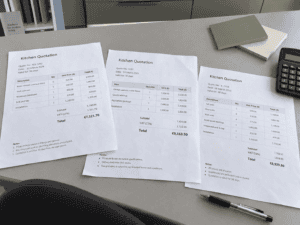
You have three quotes on the table, all within a few hundred euro of each other. That is where most people relax and pay a deposit, and where the budget stops being accurate. Those numbers price the kitchen: cabinets, worktop, doors, labour. The rest arrives afterwards in pieces, once the deposit is gone. Below is a list of those pieces with real 2026 Irish prices, from people who quote kitchens for a living and have had the awkward phone call about the fuse board.
Contents
- Why costs go missing
- The strip-out
- Electrics
- Plumbing and gas
- Walls and floors
- Extraction
- Structural work
- Delivery and access
- Living without a kitchen
- Templating
- Summary table
- Ten questions
- FAQ
Why these costs are missing
Mostly it is not dishonesty. A kitchen company quotes what it supplies. Nobody in a showroom has been under your floor or opened your fuse board, so pricing a rewire at design stage is guesswork.
That is fine until nobody says it out loud. A quote reading €14,800 with no note about exclusions reads to a normal person as €14,800. We have had customers reach strip-out stage genuinely shocked that plastering was theirs to arrange, and they were not being unreasonable. Our own quotes have not always been explicit enough about this, which is a fair criticism of the trade generally, ours included. No supplier has no exclusions. Get yours written down and roughly priced before the deposit moves. Our Kitchen Cost Guide and the 2026 renovation cost breakdown cover the kitchen itself. This is the other column.
Taking the old kitchen out
If a quote says “supply and fit”, check whether it also says removal and disposal.
- Strip-out labour: €300 to €700, usually two people for a day. Tiles bedded onto plaster push it higher.
- Skip hire: €300 to €420 for a 6-yard skip in Dublin in 2026, €380 to €520 for an 8-yard, and one is rarely enough if a tiled floor is coming up too.
- Skip permit: €40 to €90 where the skip sits on a public road rather than a driveway.
- Appliance disposal: free under WEEE rules on a like-for-like replacement, but only if arranged with the retailer at point of sale. Otherwise the skip takes your fridge.
Then the one nobody raises in a showroom. In houses built before about 1980, there is a real chance of asbestos insulating board behind the units or in a textured ceiling coating. A survey costs €250 to €450, and licensed removal of a small quantity starts around €600. A fitter who offers to take it out with a crowbar has told you something useful.
The jobs that go over budget are almost never the ones with a surprise behind the wall. They are the ones where nobody looked behind the wall. A fitter who spends forty minutes at survey lifting a floorboard and opening the fuse board hands you a bigger number, and that is the honest one.

Electrics and the certificate
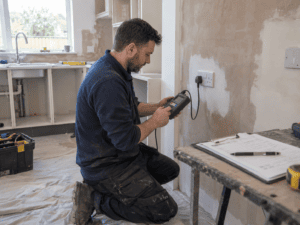
A 1990s Irish kitchen was built around four sockets, a cooker point and a strip light. A 2026 kitchen wants induction, an integrated oven, a dishwasher, under-cabinet lighting and enough worktop sockets for a kettle, toaster and air fryer at once.
| Electrical item | Typical 2026 cost | When it applies |
|---|---|---|
| Extra socket on an existing circuit | €80 – €150 each | Most jobs add three to six |
| Dedicated radial circuit for induction | €250 – €500 | New induction, or hob moving |
| Relocating the cooker point | €180 – €400 | Hob or oven moving |
| Under-cabinet and plinth lighting | €250 – €600 | Unless specified |
| Consumer unit upgrade, RCD protection | €600 – €1,100 | Board full, no RCBOs |
| Partial rewire of the kitchen | €1,200 – €2,500 | Rubber or early PVC wiring |
| Safe Electric completion certificate | €80 – €200 | Notifiable work |
An induction hob needs a circuit sized for its load, and if the board is full then the board comes first, which is how a €400 job becomes €1,300 in an afternoon. The certificate is not optional either: it must come from a Registered Electrical Contractor, and a solicitor will look for it when you sell.
Plumbing, waste and gas
Leaving the sink where it is costs nothing. Moving it costs more than people expect, because the waste needs a fall to the stack.
- Sink moving one to two metres along the same wall: €300 to €700.
- Sink moving to a new wall or an island: €600 to €1,400, more where a concrete slab has to be chased.
- New dishwasher supply and waste: €150 to €350.
- Renewing old imperial copper or lead tails to take 15mm fittings: €300 to €900, common in 1930s to 1950s Dublin terraces.
- Moving or capping a gas hob point: €200 to €450, and only by an installer on the Register of Gas Installers of Ireland.
- Relocating a boiler or flue: €700 to €2,000, whenever the boiler press is where the tall units want to go.
Walls and floors afterwards
The most commonly missed cost, and not a small one. When the old kitchen comes off, what is left is not a wall. It is plaster with fixings pulled out of it, patches of tile adhesive, and fresh chases across all of it. New units will not hide that, because the new layout is never identical.
| Making good | Typical 2026 cost |
|---|---|
| Patch plastering and skim, two walls | €450 – €1,000 |
| Full re-skim where old adhesive covers the wall | €800 – €1,600 |
| Painting, once plaster has dried 5 to 10 days | €350 – €750 |
| Lifting an old tiled floor | €250 – €600 |
| Self-levelling compound or screed | €18 – €35 per m² |
| New floor supplied and laid | €45 – €110 per m² |
One detail catches out more renovations than any other: floor height. A new tiled floor laid over the old one raises the finished level 15mm to 25mm. Integrated appliances are built to a fixed housing height, so a dishwasher that fitted before may no longer slide under the worktop. Agree the finished level with your fitter before the floor goes down.
Extraction and ducting
Most people want the extractor ducted outside until they hear what that involves in a house that never had one. Core drilling a 125mm or 150mm hole through a solid external wall is €120 to €280, and rigid ducting with an external cowl adds €150 to €450. Ducting an island hood under the floor or through a ceiling bulkhead is €400 to €1,200, and must be designed before the floor closes up.
A 600mm rubble stone wall in a Victorian terrace is a different job from cavity block, and an apartment usually cannot take a new external penetration without management company consent, which is why recirculating hoods are standard there. Check before picking from our extractor fan range.
Structural work
- Removing a non-load-bearing stud wall: €400 to €900 including making good, provided it genuinely is non-load-bearing, which an engineer confirms, not a fitter.
- Removing a chimney breast: €1,500 to €3,500, plus €300 to €600 for an engineer’s certificate, because the stack above still needs support.
- Strengthening a timber first floor under a stone-topped island: €400 to €1,200. A 3m quartz top is a real point load, and while most floors take it, “most” is not a survey.
- Forming a larger opening for patio doors leaves the kitchen budget entirely and becomes a building project with an engineer and a steel.
Most internal kitchen work here is exempted development, but the exemption has limits around extensions, front elevations and protected structures. Our guide to common renovation mistakes covers the sequencing errors that follow.
Delivery and access
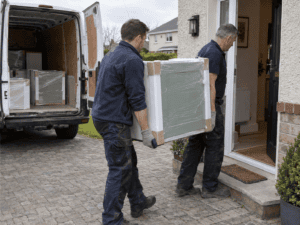
Standard delivery in Ireland is kerbside, meaning the driver leaves the kitchen at your gate, not in your hall.
- Two-man delivery or placement inside: €80 to €250.
- A kitchen going upstairs adds labour and sometimes a full day, since pre-assembled tall units are awkward on a stairs turn.
- Apartment lifts have a maximum internal dimension and a 2150mm larder unit does not always fit. Measure the lift, not just the kitchen.
- Stone worktops are carried in flat by two or three people, so a tight hall turn is a constraint the fabricator needs at template stage.
- Parking for the lorry and the fitters’ van in a controlled parking zone: €30 to €90 a week.
An on-site survey exists to catch this, as our guides to kitchen installation in Ireland and a Dublin fit set out.
The cost of not having a kitchen
This never appears on a quote and is often larger than the skip and the plastering combined. For two to four weeks you have no sink and no hob.
| Living cost during the works | Typical figure |
|---|---|
| Couple, takeaways and eating out | €90 – €180 per week |
| Family of four, same | €150 – €320 per week |
| Temporary kitchen (microwave, kettle, hob plate) | €100 – €250 once off |
| Laundrette, where the machine is in the kitchen | €25 – €60 per week |
Three weeks with a family of four is comfortably €500 to €1,000 nobody wrote down, which is the best argument for asking hard questions about lead times. Our guide to kitchen finance and payment options covers how people stage the spend.
Templating and the second visit
A stone worktop cannot be measured off a drawing. It is templated on site once the base units are fitted and level, because a millimetre of error over a 3m run is visible. Template to fitted worktop is typically 7 to 14 working days.
So the fitters install the cabinets and leave. Then one to two weeks with no worktop, no sink and no hob. Then a shorter second visit for the worktop, the sink and tap, the hob and the splashback. Some installers price that visit in, some charge €150 to €350. Know which you signed up for. Laminate largely avoids it, being cut on site the same week, as our worktop installation guide explains.
Everything in one table
| Item | Typical € range | Trigger | Priceable up front? |
|---|---|---|---|
| Strip-out labour | €300 – €700 | Always | Yes |
| Skip hire and permit | €300 – €520; permit €40 – €90 | Always; two if lifting a floor | Yes, fixed price |
| Asbestos survey / removal | €250 – €450; €600 – €1,500+ | Pre-1980 houses | Survey yes, removal after |
| Extra sockets and lighting | €80 – €150 each; €250 – €600 | Nearly always | Yes, after a site visit |
| Induction hob circuit | €250 – €500 | New induction, or hob moving | Yes |
| Consumer unit upgrade | €600 – €1,100 | Board full or no RCD | Yes |
| Safe Electric certificate | €80 – €200 | Notifiable work | Yes |
| Moving sink and waste | €300 – €1,400 | Sink changing position | Yes, once layout agreed |
| Renewing old pipework | €300 – €900 | Pre-1960s houses | Rarely, until units are out |
| Gas hob move (RGI) | €200 – €450 | Gas hob relocating | Yes |
| Plastering, making good, painting | €800 – €2,350 | Always | Yes |
| Floor lift, levelling, new floor | €550 – €1,400 plus €45 – €110/m² | Floor changing | Yes; agree finished height |
| Extractor drill and ducting | €270 – €730; island €400 – €1,200 | No existing vent | Yes, if surveyed |
| Stud wall or chimney breast removal | €400 – €900; €1,800 – €4,100 | Opening the room up | Yes, with an engineer |
| Floor strengthening for island | €400 – €1,200 | Timber floor, stone top | After an engineer calls |
| Delivery carry and parking | €80 – €250; €30 – €90 a week | Upstairs or CPZ | Yes, at order stage |
| Eating out, temporary kitchen | €200 – €1,000 total | Always | Yes, with a schedule |
| Worktop return visit fee | €0 – €350 | Stone worktops | Yes, ask directly |
On a typical Dublin renovation these land between €2,500 and €7,000 on top of the kitchen, depending on the age of the house and how much the layout changes. Budget 20% to 30% of the quote for what it does not cover.
Ten questions to ask
Bring these to every showroom and write the answers down. A supplier who answers all ten without flinching is telling you something, and so is one who does not. Our Dublin showroom buyer’s guide covers what else to weigh.
- What exactly is excluded from this quote, in writing?
- Does the price include taking the old kitchen away, or only off the wall?
- Who pays for the skip, and how many will this need?
- Is electrical work included, and who issues the Safe Electric certificate?
- Has anyone looked at my fuse board, and will the new circuits fit it?
- Is plastering, making good and painting included, or mine to arrange?
- What finished floor height are you designing to, and when must it be laid?
- If I want the extractor ducted outside, what does that involve here?
- How many days between cabinets and worktop, and is the second visit charged?
- What is the payment schedule, and what does the warranty cover on labour as against materials?
On the last one, ask to see the terms rather than a summary. Ours are on the warranty policy page, and any supplier should point you at theirs.
Where this leaves your budget
None of this argues against renovating. It argues against budgeting only for the part that has a brochure. The households who get through without a row about money are not the ones who spent least. They knew in week one that the plasterer was coming in week three, and roughly what he would charge. Twenty per cent contingency is sensible. Ten is optimism. There is more on sequencing in the 2026 planning guide, and finished work in our projects gallery.
Frequently Asked Questions
What are the most common hidden costs in a kitchen renovation in Ireland?
Plastering and making good after the strip-out, skip hire, electrical upgrades, ducting for the extractor, and eating out while the kitchen is gone.
How much should I budget on top of my kitchen quote?
Around 20% to 30% of the quote, roughly €2,500 to €7,000 on a typical Dublin job. A newer house with an unchanged layout sits at the low end.
Is removing the old kitchen usually included in the price?
Sometimes the removal is included but the disposal is not. Ask whether the old units leave the property, and who pays for the skip.
Do I need a certificate for electrical work in a new kitchen?
Yes. Adding circuits, moving a cooker point or changing the consumer unit is notifiable work and must be certified by a Registered Electrical Contractor, typically €80 to €200.
Why do I need plastering if the new units cover the walls?
Because the new layout is never identical to the old one, so bare patches, old adhesive and chases show wherever the cabinets do not reach. Expect €450 to €1,600.
How long will I be without a kitchen?
Two to four weeks, longer with a stone worktop, since templating happens after the cabinets are fitted and fabrication takes 7 to 14 working days.
Can I lay the new floor before the kitchen is fitted?
You can, but the finished height must be agreed with your fitter first. Raising it 15mm to 25mm can leave integrated appliances unable to slide under the worktop.
Will I need planning permission for a kitchen renovation?
Internal kitchen work is normally exempted development. Extending, altering the front elevation or working on a protected structure is different, with limits worth checking early.
Is there asbestos in old Irish kitchens?
Possible in houses built before about 1980, usually as insulating board in a boiler press or a textured ceiling coating. A survey is €250 to €450, removal from around €600.
Related Kitchen Projects & Guides
- Kitchen Cost Guide
- Kitchen Renovation Cost Ireland 2026
- Kitchen Renovation Mistakes
- Dublin Kitchen Installation: What to Expect
- Kitchen Renovation Dublin
Want the exclusions list before you commit? Book a free design consultation and we will survey the room, tell you which items above apply to your house, and put the answers in writing beside the quote. Or get in touch with a question first.