Dublin Kitchens

Kitchen Worktop Materials in Ireland — The Complete Comparison Guide
Your worktop gets more abuse than almost anything else in the kitchen. Hot pans, sharp knives, red wine spills, kid’s art projects — it takes all of it, every day, and you still expect it to look good five years later. The material you pick determines whether that’s a reasonable expectation or a slow-motion disappointment.
Most people choose their worktop based on two things: how it looks, and how much it costs. Both matter, obviously. But so do things like how much maintenance it needs, whether it stains or scratches easily, and how it handles a hot pot straight off the hob. Get those wrong and you’ll be looking at a surface you resent every time you wipe it down.
We’ve installed thousands of worktops in kitchens across Dublin and Ireland, across every material type there is. Here’s how they compare.
The Overview: Five Materials at a Glance
| Laminate | Quartz | Granite | Solid Surface | Solid Wood | |
| Price per linear metre | €60-120 | €300-600 | €350-700 | €250-400 | €200-400 |
| Durability | ★★ | ★★★★★ | ★★★★★ | ★★★★ | ★★★ |
| Heat resistance | Poor | Excellent | Excellent | Moderate | Moderate |
| Stain resistance | Good | Excellent | Good (needs sealing) | Good | Poor (needs regular oiling) |
| Scratch resistance | Moderate | Excellent | Excellent | Moderate (can be sanded) | Poor (can be sanded) |
| Seam visibility | Visible | Near-invisible | Visible | Invisible | Visible |
| Maintenance | Wipe clean | Wipe clean | Annual sealing | Wipe clean, occasional sanding | Regular oiling |
| Lifespan | 10-15 years | 25+ years | 25+ years | 20+ years | 15-20 years |
Now let’s go through each one properly — the good, the bad, and the stuff the brochures don’t mention.
Laminate Worktops
Laminate worktops are the budget option, but “budget” doesn’t mean “bad.” Modern laminates are nothing like the peeling, bubbling surfaces you might remember from rental flats in the 90s. The technology has moved on considerably.
A laminate worktop is essentially a high-density chipboard or MDF core wrapped in layers of resin-impregnated paper, with the top layer printed with the desired pattern — wood grain, stone effect, concrete look, solid colour, whatever you want. A good-quality laminate has a thick wear layer that handles daily use surprisingly well.
What’s good about them: The price, mostly. A full kitchen’s worth of laminate worktops might cost €600-1,200, compared to €3,000-6,000 for quartz. They’re light, easy to cut, and DIY-friendly if you’re installing a flat pack kitchen yourself. The pattern range is enormous — you can get convincing wood and stone effects that look far more expensive than they are from a metre away.
What’s not: Heat is the enemy. Put a hot pan directly on a laminate worktop and you’ll leave a mark — possibly a permanent one. They can’t be repaired if deeply scratched or burned; you replace the whole section. Water ingress at joints is the most common failure point — if the seal between two sections breaks down and water gets into the chipboard core, the worktop swells and there’s no fixing it.
Best for: Budget-conscious renovations, rental properties, and flat pack kitchen installations where you’re doing the work yourself.
Our take: Laminate is a perfectly sensible choice if you’re careful with hot pans and stay on top of joint sealing. It’s not a lifetime product, but at the price, it doesn’t need to be.
Quartz Worktops
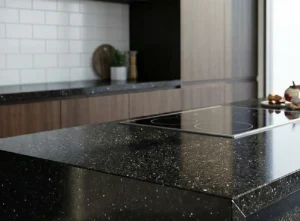
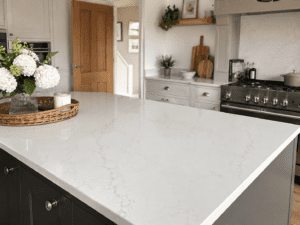
Quartz is the current market leader in Irish kitchens, and for good reason. Engineered quartz is made from roughly 90% natural quartz stone mixed with resins and pigments, pressed into slabs under enormous pressure. The result is a surface that’s harder and more consistent than natural stone, with none of the unpredictability.
What’s good about them: Quartz is practically indestructible in normal use. It doesn’t stain — red wine, coffee, turmeric, all wipe off without trace. You can put a hot pan on it (though we still recommend a trivet). It doesn’t need sealing, ever. The colour and pattern are consistent across the whole slab, so what you see in the showroom is exactly what arrives. Seams between slabs are nearly invisible when done properly.
What’s not: The price. Quartz is a significant investment. It’s heavy — two people can’t carry a slab, and the installation requires proper equipment. Once it’s in, you can’t change it without destroying the cabinets underneath (the worktop is bonded to them). Some of the cheaper imported quartz can yellow slightly over time if exposed to strong direct sunlight — worth asking about UV stability if your kitchen gets a lot of sun.
Best for: Homeowners who want a premium surface they won’t have to think about for 20+ years. Kitchens with islands where the worktop is a focal point.
Our take: If your budget allows, quartz is the closest thing to a no-regrets decision in kitchen worktops. It’s what we recommend to most customers who can stretch to it.
See quartz worktop options at our showroom →
Granite Worktops
Granite is natural stone, cut from quarries and polished into slabs. Every piece is unique — the veining, speckling, and colour variations in one slab won’t match the next. For some people, that’s the appeal; for others, it’s a frustration when the installed result doesn’t quite match the sample.
What’s good about them: Granite is incredibly hard and heatproof — you genuinely can put a hot pan directly on it without damage. It’s a natural material with a depth and character that engineered stone can’t quite replicate. A well-chosen granite worktop is a genuine feature in the room.
What’s not: Granite is porous — not dramatically, but enough that it needs sealing when installed, and resealing every year or two. If you skip the sealing, it will eventually absorb oil and water stains, particularly around the sink and hob. Some granites are surprisingly brittle and can chip at the edges if you knock a heavy pan against them. Repairing a chip is possible but never invisible.
Colour consistency is the other issue. Your sample shows a small section; your actual slab might have more movement, darker veins, or colour patches that weren’t obvious in the 10cm sample square. Always, always view the actual slab before fabrication.
Best for: Traditional or classic-style kitchens where natural materials are important to the overall look. Homeowners who don’t mind the annual sealing routine.
Our take: Granite was the premium choice for decades, and it’s still an excellent material. But quartz has overtaken it in popularity, and for practical reasons — the lack of maintenance is hard to argue with. If you love the look of natural stone, go granite. If you want the easiest life, go quartz.
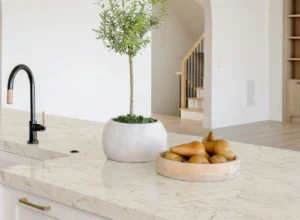
Solid Surface Worktops (Corian-type)
Solid surface materials — Corian is the best-known brand, but there are others — are made from acrylic resin mixed with mineral fillers. They’re warm to the touch (unlike stone), can be moulded into curves and integrated sinks, and have completely invisible seams.
What’s good about them: Seams genuinely disappear. Two pieces are joined with a colour-matched adhesive and sanded flush — you can’t see or feel the join. This means you can have a worktop that flows seamlessly into an upstand, a sink, or a draining board, all in the same material with no visible breaks. Scratches can be sanded out and the surface restored to new. The feel is warmer and softer than stone — less clinical.
What’s not: They scratch more easily than quartz or granite. This isn’t necessarily a deal-breaker — minor scratches can be buffed out with a Scotch-Brite pad — but it does mean the surface develops a patina over time. They’re not as heat-resistant as stone; a very hot pan can leave a mark. The price sits between laminate and quartz, but installation is specialised and costs more than laminate fitting.
Best for: Contemporary kitchens with integrated sinks, curved shapes, and a seamless look. Designers love solid surface for its fabrication flexibility.
Our take: Solid surface is a design-led choice. If the seamless, integrated look is important to you, it’s brilliant. If you want the toughest possible surface, go quartz.
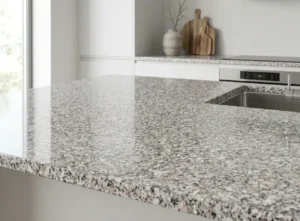
Solid Wood Worktops
Timber worktops — oak, walnut, iroko — have a warmth that stone and resin can’t match. They age, develop character, and can be sanded back to new when needed.
What’s good about them: They’re beautiful. There’s no argument about that. Wood adds warmth and texture that makes a kitchen feel lived-in rather than showroom-sterile. They can be sanded and re-oiled to remove stains and scratches, effectively resetting the surface every few years. With proper care, a wood worktop lasts decades.
What’s not: Maintenance. Wood needs regular oiling — every few months initially, then every 6-12 months once established. Without it, the timber dries out, water penetrates, and you get black staining around the sink that’s impossible to remove without aggressive sanding. They dent and scratch easily. Hot pans leave marks. Red wine spills need immediate attention or they’ll stain permanently. Wood around a sink area is a constant battle that some people are fine with and others despise.
Best for: Traditional kitchens, kitchen islands (where the worktop can be the star), and homeowners who actively enjoy maintaining natural materials.
Our take: We’d suggest using wood on an island or a breakfast bar — somewhere it’s visible and beautiful but not doing the heavy lifting of daily food prep. Put quartz or laminate on the main run, wood on the island. Best of both worlds.
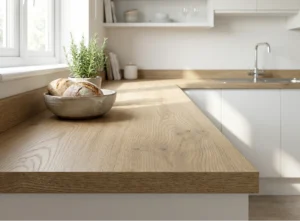
→ Shop Laminate Worktops Now: Torro Cremona Oak – Kitchen Worktops 38mm Thickness
Which Worktop is Right for You?
| If you… | Choose |
| Want the toughest, lowest-maintenance surface | Quartz |
| Are on a tighter budget but still want it to look good | Laminate |
| Love natural stone and don’t mind annual sealing | Granite |
| Want seamless, integrated design with no visible joins | Solid Surface |
| Love the warmth of natural materials and will maintain them | Solid Wood |
| Want the best of both | Quartz on main run, wood on island |
Frequently Asked Questions
Q: Can I fit a new worktop on my existing kitchen cabinets?
A: Yes, as long as the cabinets are in good condition and the layout isn’t changing. This is a common way to refresh a kitchen without replacing everything. The old worktop is removed, the cabinets are checked, and the new worktop is fitted. It’s a day or two of work rather than weeks.
Q: Which worktop adds most value to an Irish home?
A: Quartz. It’s what buyers expect in a mid-to-upper-range kitchen, and it photographs well for viewings. Granite can look dated if it’s a busy pattern from the early 2000s. Solid wood puts some buyers off because they anticipate the maintenance.
Q: How thick should a worktop be?
A: Standard is 20-40mm depending on the material. Laminate is usually 38mm. Quartz and granite are typically 20mm or 30mm — 20mm gives a sleek, contemporary look, while 30mm feels more substantial. There’s no functional difference; it’s purely aesthetic.
Q: Can I cut directly on a stone worktop?
A: You can, but you shouldn’t. Stone will dull your knives far faster than a chopping board. Use a board. Your knives will thank you, and your worktop won’t develop the kind of micro-scratches that catch the light in an annoying way.
See Worktops in Person
Photos and descriptions only get you so far. A quartz sample that looks perfect on screen might feel completely different when you see a full slab in person. The same goes for wood grain, laminate patterns, and stone finishes — the scale and texture are impossible to judge from a website.
Our Dublin showroom has over 20 worktop finishes on display, across all five material types. You can run your hand over them, see them in natural light, and hold them against cabinet door samples to see how they work together.
📅 Book a Free Design Consultation →
Already chosen your worktop? Make sure your cabinet sizes are right with our kitchen cabinet sizes guide →