Dublin Kitchens

Kitchen Drawers in Ireland: Types, Sizes, Runners and Prices
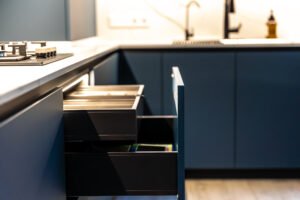 Count how many times a drawer gets opened in your kitchen on an ordinary Tuesday. The cutlery drawer alone will take forty or fifty pulls before the dinner things are washed up. Nothing else in the room works that hard, which is why drawers are where a cheap kitchen shows itself first, and most of that difference sits in a part you never see once the kitchen is fitted: the runner. Here are the drawer types worth knowing, the sizes you’ll be quoted in millimetres, the runner grades compared honestly, and what each costs in Ireland in 2026.
Contents
- The drawer types you’ll be offered
- Drawer runners compared
- Soft-close: built in or bolted on
- Sizes, heights and weight ratings
- Three drawers or a door and a drawer?
- Trays, dividers and liners
- Adding drawers to existing cabinets
- Prices in Ireland (2026)
- FAQ
The drawer types you’ll be offered
Terminology varies between suppliers, which makes comparing two quotes harder than it should be. These are the categories you’ll meet on an Irish specification.
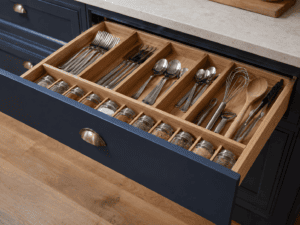
- Cutlery drawer — the shallow top drawer, 90mm to 140mm high internally. Available as a drop-in kit for a standard base carcass, or built into a three-drawer unit such as the 900mm cutlery-and-pot combination.
- Pot drawer — the deep one, 180mm to 280mm internally, sized for saucepans and casserole dishes standing up rather than stacked. A 1000mm two-pot-drawer base unit is the same construction with a taller drawer side.
- Pan drawer — most Irish suppliers use this interchangeably with pot drawer. Where a distinction is made, a pan drawer sits mid-height and the pot drawer is deepest.
- Internal drawer — a drawer behind a hinged door, no front of its own. Useful for an unbroken door line, or inside a tall larder, but it costs more per drawer for less usable height.
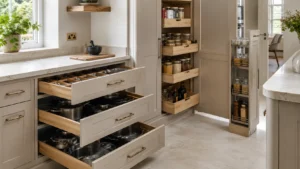
- Pull-out larder — a tall narrow unit, 150mm to 300mm wide, on heavy base-mounted gear. Very good for tins and jars, poor for anything tall or awkward.
- Corner pull-out — the mechanism that gets a blind corner back into use. The most expensive storage per litre in the kitchen, and still usually worth it, since the alternative is a metre of cabinet nobody can reach. Price it against a plain L-shaped corner base unit.
- Specialist pull-outs — a 300mm pull-out bin or a 450mm laundry basket unit runs on the same gear, with the same failure modes.
Boxes, kits and fittings sit under drawer options, the wider range in kitchen storage.
Drawer runners compared — the part that matters
Two drawers can have identical fronts, identical boxes and identical widths, and one will be rattling and dropping at the front within three years while the other closes exactly the same way in year twelve. The runner is the difference, and it’s rarely itemised on a quote unless you ask.
| Runner type | Extension | Load rating | Cycle life | Soft-close | Extra per drawer |
|---|---|---|---|---|---|
| Side-mounted epoxy roller (plastic wheels, visible at the drawer side) | Partial, 70–80% | 20–25kg | ~20,000 cycles | Clip-on damper at best | Baseline, in budget flat-pack |
| Ball-bearing side runner (steel telescopic) | Full, 100% | 30–35kg | ~50,000 cycles | Add-on damper, integrated at the top of the range | €8 – €20 |
| Under-mount full-extension soft-close (Blum Tandem, Hettich Quadro and equivalents) | Full, 100%, invisible from above | 30–50kg, heavy-duty to 60kg | 60,000 – 100,000 cycles | Built in, adjustable tension | €25 – €60 |
Three columns there deserve a sentence each. Partial extension means the back 100mm of the box never clears the carcass, so you reach blind into the part where awkward things migrate. Load rating is not marketing: a pot drawer holding cast iron genuinely carries 25kg, and a 20kg roller asked to do that daily is why cheap drawers sag at the front. And cycle life is the honest number: twenty thousand cycles sounds enormous until you divide it by forty daily pulls, at which point it’s eighteen months before the wheels flat-spot.
Under-mount runners carry a second advantage, nothing to do with durability. The gear sits beneath the box rather than either side of it, so you gain roughly 30mm of internal width in the same cabinet, which in a 400mm unit is a baking tray fitting or not fitting.
The call-outs we get on drawers are almost never a broken drawer box. It’s a front that has dropped 3mm on one side, or a drawer that won’t stay shut on a floor with a bit of fall in it, and nine times out of ten it’s a side roller runner three or four years into a family kitchen. Nobody picks their runners in the showroom, because nobody knows to ask. The ones who did ask we never hear from again.
Soft-close: built in or bolted on
Soft-close is sold as a single feature and it isn’t. There are two ways of getting it, and they don’t age the same.
An integrated soft-close is engineered into the runner. The damping cylinder sits inside the mechanism, the closing force is matched to the load rating, and the tension is usually adjustable, so a loaded pot drawer and an empty cutlery drawer both close at a sensible speed. It carries the runner’s warranty.
A bolt-on damper is a small piston clipped to an existing runner. It’s a real improvement on nothing, and it’s what “soft-close available” usually means on budget flat-pack drawers. But it’s tuned for one weight, so a full pot drawer will still hit the stop, and both clip and piston are wear parts a heavy pull can knock out of line. Ask which one you’re getting.
Drawer sizes, heights and weight ratings
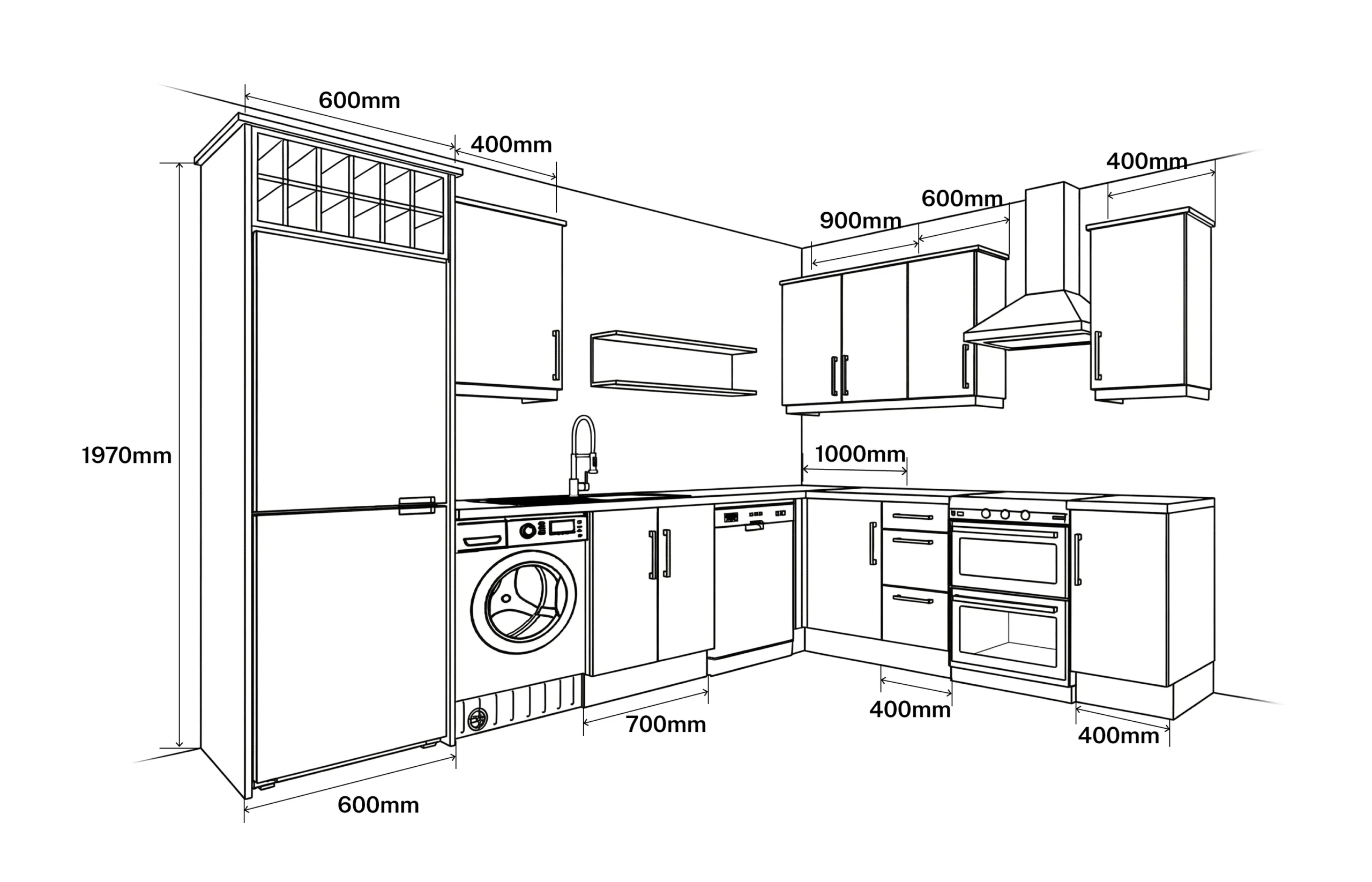
Drawer widths follow cabinet widths, so the table gives cabinet sizes and the internal width you end up with. Standard Irish base carcasses are 720mm high and 560mm to 570mm deep, suiting a 500mm or 550mm runner. Our guide to kitchen cabinet and unit sizes in Ireland covers heights, depths and plinths in full.
| Cabinet width | Internal width (18mm carcass) | Sensible drawer count |
|---|---|---|
| 300mm | approx. 264mm | 3 shallow, or a pull-out larder instead |
| 400mm | approx. 364mm | 3 (1 cutlery + 2 pot) |
| 500mm | approx. 464mm | 3 (1 cutlery + 2 pot) |
| 600mm | approx. 564mm | 3 (1 cutlery + 2 pot) |
| 800mm | approx. 764mm | 3 — 800mm 3-drawer base unit |
| 900mm | approx. 864mm | 3 — 900mm 3-drawer base unit |
| 1000mm | approx. 964mm | 2 deep — 1000mm pot drawer base unit |
Heights split into two bands, and it pays to use the right words when you order. A cutlery drawer is 90mm to 140mm internally, with a front of roughly 140mm to 180mm once the gap and rail are allowed for. A pot drawer is 180mm to 280mm internally, with a front around 280mm to 355mm.
On weight, 25kg is the rating you get without asking, and it’s fine for cutlery, utensils, food boxes and most pans. Ask for 40kg or better on the bottom drawer of any unit holding cast iron, a stand mixer or stacked plates, and on island drawers, which get pulled at an angle rather than square on.
Three drawers or a door and a drawer?
This comes up at nearly every design consultation and most people expect us to sit on the fence. For a base unit storing pots, pans, food or crockery, three drawers beats a drawer over a cupboard almost every time.
The reason is mechanical. A door-and-drawer unit has a fixed shelf halfway down, and everything below it is retrieved by crouching, reaching past the hinge and lifting items out over a lip. Anything at the back of the lower half effectively stops existing. Three drawers bring the contents out to you at standing height, visible from above. In a 600mm unit that’s using around 60% of the volume versus nearly all of it.
The honest counter-argument is cost. Three drawers run roughly €55 to €110 more per 600mm unit than the same cabinet with a door and one drawer, since you’re paying for three boxes, three sets of runners and three fronts instead of one of each plus a shelf. Across six units that’s €330 to €660.
Doors still win under the sink, where the trap and isolating valves make a drawer impractical; in any unit housing an integrated bin or appliance; and on a tight budget. That last is the point we’d press hardest: four drawer units on good under-mount runners make a better kitchen than eight on rollers. Our kitchen cabinet prices guide and kitchen cost guide put these figures in context.
Inside the drawer: trays, dividers and liners
An empty 800mm pot drawer is a lovely thing until the third week, when everything in it has migrated to one corner. Three fittings earn their place:
- Cutlery trays — moulded plastic at €12 to €25 is perfectly serviceable; timber or cut-to-size runs €35 to €90. Measure the internal width, not the cabinet size.
- Adjustable dividers — spring-loaded or peg-set rails that stop plates and lids sliding, €15 to €40 per drawer. The best value fitting on the list.
- Non-slip liner — a €10 roll of ribbed matting cut to size. Stops glassware rattling and light items travelling on every close. Unglamorous, and what we recommend most.
Our guide to kitchen storage solutions in Ireland covers the rest, zone by zone.
Adding drawers to cabinets you already have
Plenty of people come at this from the other direction: the carcasses are sound, the doors are fine, but the drawers are shot or there aren’t enough of them. Retrofitting is often worth doing and is sometimes not possible at all. Ten minutes with a tape tells you which.
Swapping an existing drawer box
Measure three things. The internal clear width between the carcass sides where the runner fixes, not the nominal cabinet size: a 600mm unit in 18mm board gives 564mm, in 15mm board 570mm, and a site-built carcass at 592mm takes neither standard kit. The carcass depth, which sets runner length, since a 550mm runner in a 500mm carcass won’t close. And the existing front height, because a like-for-like swap keeps your door line intact while a mismatch means new fronts right across the run.
Converting a door-and-shelf cabinet to drawers
This is where it usually falls down, and the deciding factor is the centre rail. Many door-fronted base units have a horizontal rail across the front of the carcass at mid-height, bracing the box. Where that rail is structural, no full-height drawer can pass it. Most modern rigid and flat-pack carcasses have only a top brace, in which case conversion is realistic.
Check all of these before ordering: no centre rail across the opening; a flat, unobstructed base for under-mount brackets; internal clear width at a standard size; carcass depth of 500mm or more; and enough clear height to stack your fronts with a 3mm gap between each.
The part people underestimate is the fronts. One door becomes three, and matching an eight-year-old painted or vinyl door is difficult. Beyond a couple of cabinets, a full set of replacement doors and drawer fronts costs less than a patchy match, particularly with new handles at the same time.
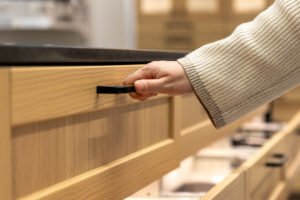
Kitchen drawer prices in Ireland (2026)
Realistic supply-only ranges for 2026. Fitting is separate: on a retrofit, €25 to €45 per drawer for a straight swap, more where fronts need aligning.
| Item | Roller runner | Ball-bearing full extension | Under-mount soft-close |
|---|---|---|---|
| Cutlery drawer kit, 500/600mm (box and runners only) | €22 – €35 | €35 – €55 | €55 – €95 |
| Pot drawer kit, 500/600mm (box and runners only) | €28 – €45 | €45 – €70 | €70 – €120 |
| 600mm 3-drawer base unit, with fronts | €150 – €215 | €195 – €280 | €260 – €390 |
| 800mm 3-drawer base unit, with fronts | €185 – €260 | €235 – €330 | €310 – €460 |
| 1000mm 2-deep-drawer base unit, with fronts | €195 – €270 | €245 – €345 | €320 – €480 |
| Corner pull-out mechanism, blind corner | Not offered | €220 – €360 | €360 – €650 |
Two notes on reading that. Complete cabinet prices move with door style as much as runner grade, so a painted MDF Shaker front sits at the top of each range and a vinyl-wrapped slab near the bottom for identical gear. And upgrading from roller to under-mount across six drawer units costs around €450 to €900. On a kitchen at €8,000 to €15,000 that’s one of the highest-return lines available, and the one cut first, because it doesn’t show in a photograph. Our flat pack kitchens range lets you specify drawer units individually rather than accept a fixed package.
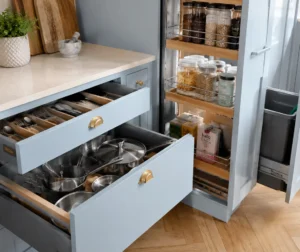
Where to spend and where not to
The order we’d argue for: full extension on every drawer before soft-close on any of them, because reaching into a dark back corner is a daily annoyance and a soft-close is a pleasantry. Then the higher load rating on the bottom drawer of each unit. Then soft-close, integrated rather than clipped on. Trays and dividers can be bought any time; runners can’t be upgraded without stripping the drawer out, so they’re the decision to get right on day one.
If you’re only doing part of the kitchen, drawers are a sound place to start. Swapping four door-and-shelf base units for three-drawer units in the cooking zone changes how a kitchen works far more than a new worktop does, as several recent fits in our kitchen projects gallery show.
Frequently Asked Questions
What is the standard depth of a kitchen drawer in Ireland?
Base carcasses are 560mm to 570mm deep, taking a 500mm or 550mm runner. The box itself is usually 450mm to 500mm front to back.
What’s the difference between a pot drawer and a cutlery drawer?
Height. A cutlery drawer is 90mm to 140mm internally and sits at the top of a unit; a pot drawer is 180mm to 280mm and takes saucepans upright. A 720mm three-drawer base unit is one cutlery drawer over two pot drawers.
Are soft-close drawers worth the extra cost?
Yes, but only after you’ve paid for full-extension runners. Soft-close is comfort, full extension is access, and if the budget stretches to one, take the extension.
How much weight can a kitchen drawer hold?
Standard runners are rated to 25kg, ball-bearing full-extension runners to 30–35kg, and under-mount systems to 30–50kg, with heavy-duty versions reaching 60kg.
Can I add drawers to my existing kitchen cabinets?
Often yes. Check there’s no centre rail across the front of the opening, that the internal clear width is a standard size, and that the carcass is at least 500mm deep. The harder part is matching new fronts to existing doors.
How long should kitchen drawer runners last?
Roller runners are tested to around 20,000 cycles, ball-bearing runners to 50,000, and under-mount systems to 60,000–100,000. In a busy family kitchen that’s roughly two years, six years, and longer than the kitchen itself.
Is a three-drawer base unit better than a door and drawer?
For pots, pans, food and crockery, yes, because you use close to the full volume instead of about 60% of it. Expect three drawers to add roughly €55 to €110 per 600mm unit.
What sizes do kitchen drawer units come in?
300mm, 400mm, 500mm, 600mm, 800mm, 900mm and 1000mm. Up to 900mm the standard split is three drawers; at 1000mm two deep drawers works better.
Can you replace just the drawer boxes and keep the fronts?
Yes, as long as the new box’s fixing pattern suits the front and the height matches. Typically €55 to €140 per drawer supplied and fitted.
Related Kitchen Projects & Guides
- Kitchen Drawer Options & Drawer Kits
- Kitchen Cabinet & Unit Sizes in Ireland
- Kitchen Storage Solutions Ireland
- Kitchen Units Ireland: Types, Sizes & Prices
- Light Grey Handleless U-Shaped Kitchen in Swords, Dublin
Not sure which drawer spec your kitchen needs? Book a free design consultation and we’ll measure your existing carcasses and tell you honestly whether a retrofit works, or get in touch with the measurements you already have.