Dublin Kitchens

Kitchen Presses in Ireland: Sizes, Styles & Prices (2026)
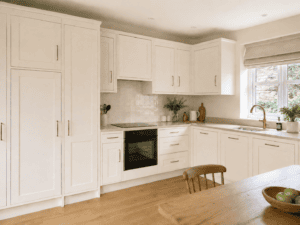
This guide is for two people who land on the same page. The first is planning a full kitchen and wants the types, the sizes and what a run of presses costs. The second has presses that are structurally fine but doors that look twenty years old, and wants to know whether swapping only the doors is a real option or a false economy. Both are below, in mm and €.
Contents
- The five types of kitchen press
- Standard press sizes in Ireland
- Press doors: styles and materials
- What kitchen presses cost in 2026
- New doors or new presses?
- Hinges, soft-close and how a press feels
- Older Irish houses: where the trouble is
- FAQ
The five types of kitchen press
Nearly every fitted kitchen in Ireland is built from five kinds of press, and knowing which is which makes a quote far easier to read.
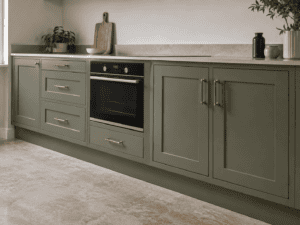
Base press
The presses that sit on the floor and carry the worktop: a single-door box with one adjustable shelf, a double-door version at wider sizes, or a drawer stack with no door at all. Drawer stacks cost more, since you’re paying for runners rather than a hinge, but they’re the one upgrade most households say they’d repeat.
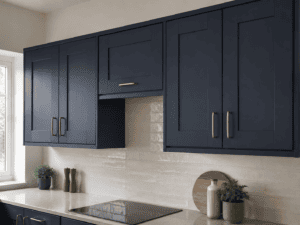
Wall press
Hung above the worktop and shallower, so you’re not standing into it while you cook. Wall presses come in two standard heights, and the taller is worth knowing about: an extra 180mm across a full run adds a lot of storage without changing the footprint of the room.
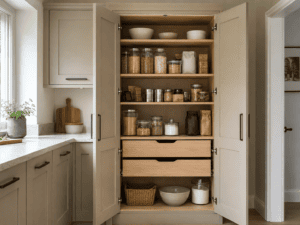
Tall press (larder)
Full height, floor to the top of the wall run. A 600mm tall larder press holds roughly what three wall presses hold, and it usually decides whether a kitchen feels organised. A double oven housing is the same carcase with shelving arranged around the appliance apertures.
Corner press
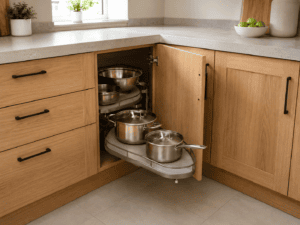
The unit everyone underestimates. Either an L-shaped carcase that turns the corner in one piece, or a blind corner where half the interior is only reachable by leaning in. The L-shaped version, like our 950mm L-shaped corner base unit, is far better in daily use and needs a specific corner press hinge so the two-piece door can fold.
Bridging press
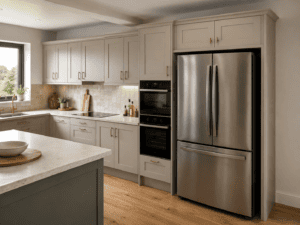
The short, wide press above a fridge, an extractor or a tall window. Cheap relative to its effect, because it closes the gap that leaves a wall run looking unfinished. Check the bridging cabinet sizes before assuming a gap has to stay a gap.
Standard press sizes in Ireland
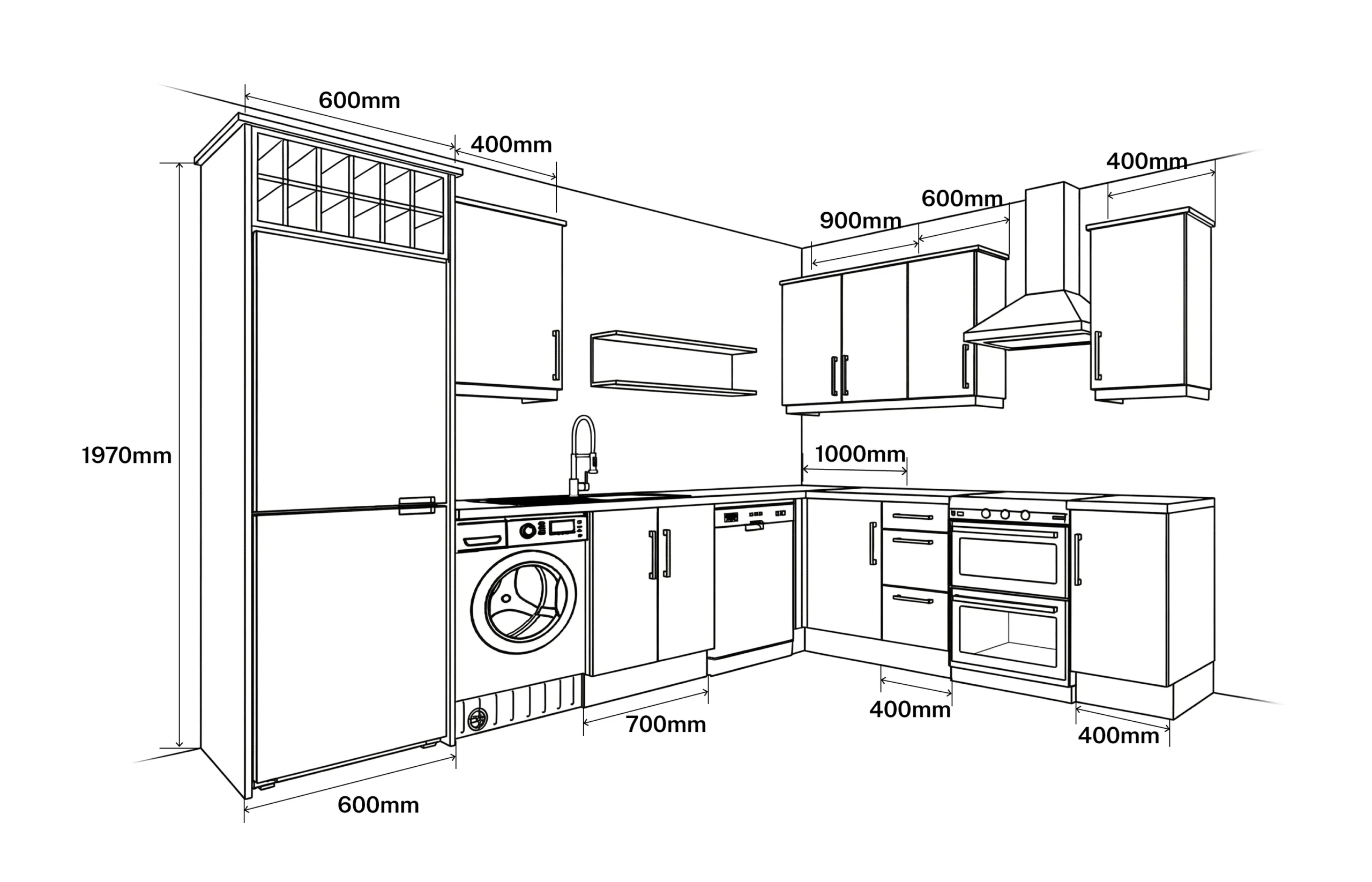
Irish kitchens are built to European metric sizes, so the numbers below hold across almost every supplier you’ll quote against. That consistency is why a door swap is possible at all.
| Press type | Standard height | Standard depth | Common widths |
|---|---|---|---|
| Base press | 720mm carcase (870–910mm finished, with plinth and worktop) | 560–570mm | 300, 400, 500, 600, 800, 900, 1000mm |
| Wall press (standard) | 720mm | 300mm | 300, 400, 500, 600, 800, 1000mm |
| Wall press (extra tall) | 900mm | 300mm | 300, 400, 450, 500, 600, 1000mm |
| Tall / larder press | 2150mm (1970mm in older runs) | 560–570mm | 400, 500, 600mm |
| Corner base press | 720mm | 560–570mm | 950 × 950mm L-shaped, or 900–1000mm blind |
| Bridging press | 300, 360 or 400mm | 300mm | 500, 600, 800, 1000mm |
Two numbers do most of the work: 720mm is the height of both a base press and a standard wall press, and 560–570mm is the depth of anything carrying a worktop. For the full tables, including plinth heights and appliance widths, see our kitchen cabinet unit sizes guide.
Press doors: styles and materials
The carcase is a box almost nobody sees. The door is the visual identity of the kitchen and, on a typical order, 40% to 60% of the cost of the presses.
- Edged MFC — melamine-faced chipboard with an ABS edge band on all four sides. The most economical door, entirely serviceable, best in woodgrains and mid-tones where a flat surface reads as deliberate. It can’t be repainted later.
- Vinyl wrapped MDF — an MDF blank routed to shape and wrapped in foil under heat and vacuum. This is how you get a Shaker profile, gloss or woodgrain at a moderate price. The weak point is heat: a vinyl door above a slot-in cooker or beside an unvented dishwasher can lift at the edge over years, so specify a heat deflector.
- Painted MDF — sprayed and lacquered, flat slab or routed Shaker. Better colour depth than vinyl, a truer matt finish, and it can be resprayed in ten years if you want a different colour rather than a different kitchen.
- 5-piece painted timber — a real frame-and-panel door: two stiles, two rails and a centre panel, assembled then painted. The dearest option, and the one that looks right in an older house with high ceilings and deep skirting. It moves slightly with humidity, which is normal.
Our cabinet materials guide goes deeper, and the five door styles explained covers Shaker, slab and handleless as a look rather than a material.
What kitchen presses cost in 2026
These are complete presses — carcase, door, hinges, shelf — in mid-range vinyl or painted MDF. Edged MFC sits at or below the bottom of each range; 5-piece timber above the top. Supplied-and-fitted assumes a straightforward Dublin fit with the old kitchen already out.
| Press | Supply only | Supplied & fitted |
|---|---|---|
| 300mm base press, single door | €75 – €130 | €130 – €200 |
| 600mm base press, single door | €95 – €170 | €160 – €250 |
| 1000mm base press, double door | €140 – €240 | €215 – €345 |
| 1000mm pot drawer base press (3 drawers) | €190 – €330 | €275 – €450 |
| 950mm L-shaped corner base press | €150 – €260 | €230 – €360 |
| 600mm wall press, 720mm high | €70 – €130 | €120 – €195 |
| 600mm wall press, 900mm extra tall | €95 – €165 | €150 – €240 |
| 600mm tall larder press, 2150mm | €230 – €420 | €330 – €560 |
| 600mm double oven housing, 2150mm | €250 – €440 | €360 – €600 |
| 1000mm bridging press | €55 – €110 | €95 – €165 |
An average Irish kitchen runs to 11–16 presses once you count the bridging units and the corner, so a full set lands around €1,800 – €4,200 supply only, or €3,000 – €6,500 supplied and fitted, before worktop, sink, tap or appliances. Flat pack rather than pre-assembled takes 10–15% off the supply cost and adds a weekend of your own time. For the whole-kitchen picture, use our kitchen cost guide and the cabinet pricing breakdown.
New doors or new presses?
The answer depends on the state of the carcases, not the age of the kitchen. A 2004 kitchen with sound carcases and tired doors is a door job. A 2014 kitchen with a swollen base under the sink and shelves starting to bow is not, however new it looks from three feet away.
Open the press under your sink and push a thumb into the base panel at the back corner. If it gives, or the edge banding has lifted and the chipboard has gone dark and soft, water has been getting in for a while and new doors won’t fix it. Then open a wall press fully and look at the hinge plate: screws chewed out of their holes are repairable, a side panel delaminating around the fixing is not.
| Situation | Better option | Rough cost, 12-press kitchen |
|---|---|---|
| Carcases sound, doors dated, layout works | Replacement doors only | €850 – €2,400 supply only |
| Carcases sound, but you want deep drawers instead of shelves | Doors plus 2–3 new base presses | €1,400 – €3,200 |
| Water damage under sink or dishwasher | Replace affected presses, doors on the rest | €1,200 – €2,900 |
| Layout wrong, or sink/hob moving | Full new presses | €3,000 – €6,500 fitted |
| Non-standard old carcases (see below) | Full new presses | €3,000 – €6,500 fitted |
A door-only job is far less disruptive too: doors arrive in two to four weeks and go on in a day, against six to ten weeks and a week on site for a full kitchen. Our replacement kitchen doors range covers the standard sizes, and the complete guide to replacement doors covers measuring and hinge positions. Measure the door, not the opening, and measure three of them — if they disagree by more than a millimetre or two, you have a non-standard kitchen.
What catches people out isn’t the door size, it’s the hinge boring. Nearly every press door made in the last twenty years is drilled 35mm diameter, 22.5mm in from the edge, but the distance from the top of the door to the centre of that hole varies between manufacturers. We’ve had customers order a full set that fitted the openings perfectly and then sat 4mm proud because the boring didn’t line up with the old hinge plates. Photograph the back of an old door with a tape against it before you order.
Hinges, soft-close and how a press feels
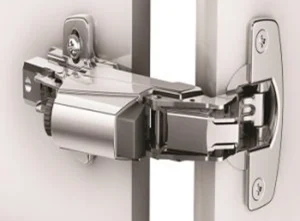
Hinges are the cheapest part of a press and the part you touch several thousand times a year. A standard concealed hinge is a clip-on 110-degree unit with three-way adjustment: sideways, in-and-out, up-and-down, each on its own screw. That is why a well-hung run has even gaps and a badly hung one doesn’t. The parts are identical; the setting-out isn’t.
- Soft-close is either built into the hinge cup or clipped to the carcase as a damper. Integrated is quieter; add-on dampers are the sensible retrofit if your hinges are sound.
- Angle matters at corners. A 110-degree hinge won’t clear an adjacent wall or a deep worktop return in a tight corner. 165-degree and corner hinges cost a few euro more.
- Overlay versus inset. Most Irish press doors are full overlay, sitting on the front of the carcase. Confirm which you have before ordering doors for old presses.
- Budget properly. Two hinges per door, three on anything over 1000mm tall or in heavy timber. At €4 – €12 a hinge, a 12-press kitchen is €100 – €250 in hinges alone, and it’s not the place to save.
The full range is on our kitchen cabinet hinges page. Handles are the other piece people leave to last and then rush — the handle range and the cup, shell and knob handle guide are worth ten minutes.
Older Irish houses: where the trouble is
Much of the housing stock here predates anyone thinking in 600mm modules, and it shows up in four predictable ways.
- Walls that aren’t straight. In a 1930s or 1950s house, 15–25mm of variation along a four-metre wall is common. Presses are square; walls are not. Scribe fillers and finishing trims exist for that, and a run planned with a filler at each end will look right where one planned wall-to-wall will not.
- Old presses that aren’t standard depth. Joiner-made presses from before the 1990s are often 500mm or 600mm deep rather than 560–570mm, with bespoke door heights. If your doors measure something like 712mm or 748mm, a door swap stops being economic and new presses are better value.
- Chimney breasts. A breast projecting 300–350mm into the room eats a press position and forces an awkward return. The usual answers are a shallow 300mm base press against the breast, a full-height larder either side, or the alcove as a place for a fridge.
- Floors that fall away. An older solid floor can drop 10–20mm across a run, which is why every base press has adjustable legs. A fitter packing units with folded cardboard instead of winding the legs down is fair to query. The plinth and cornice hide the compromise afterwards.
Where to start
If your presses are sound and you like where everything sits, spend the money on doors, hinges and handles and leave the carcases alone. If they’ve taken water, or the layout never worked, new presses are the honest answer and a door swap only postpones the decision by three or four years. What to avoid is good doors on failing presses, because you’ll pay for those doors twice.
Browse real Dublin installations in our kitchen projects gallery, see the range through shop kitchens, or have someone measure your run at a free design consultation. If storage is the real problem rather than looks, our kitchen storage fittings often solve it inside the presses you have.
Frequently Asked Questions
What is a kitchen press?
A kitchen press is the Irish word for a kitchen cupboard or cabinet: the box with a door and a shelf that a fitted kitchen is built from. British suppliers say cupboard or unit, American ones say cabinet.
Is a press the same as a kitchen cabinet?
Yes. If a listing says “base cabinet” or “wall unit” where you’d say base press, it’s the right product — sizes and hardware are identical.
What is the standard height of a kitchen press in Ireland?
720mm as a carcase, giving a finished worktop height of about 870–910mm with plinth and worktop. Wall presses are 720mm or 900mm; tall presses are usually 2150mm.
How deep is a standard kitchen press?
Base and tall presses are 560–570mm deep. Wall presses are 300mm, which keeps you from banging your head at the worktop below.
Can you replace kitchen press doors without replacing the presses?
Yes, provided the carcases are sound and the doors are a standard size with 35mm hinge boring. It’s the most cost-effective kitchen update there is and takes about a day.
How much does it cost to replace kitchen press doors in Ireland?
For a typical 12-press kitchen, €850 – €2,400 supply only depending on door material, plus €100 – €250 for hinges if the old ones are worn. Painted MDF and 5-piece timber sit at the top of that range.
How long does it take to replace press doors?
Two to four weeks from order, then a one-day fit. A full set of new presses is six to ten weeks, with about a week on site.
Will new doors fit my existing presses?
Usually, if the kitchen was fitted from about 1995 onwards to standard metric sizes. Measure the door rather than the opening, check three rather than one, and photograph the hinge positions on the back of an old door first.
What hinges do kitchen presses use?
Concealed 110-degree clip-on hinges with a 35mm cup boring, plus 165-degree and corner versions where a door must clear an obstruction. Soft-close is built in or added as a clip-on damper.
Are painted MDF press doors better than vinyl wrapped?
Painted MDF gives better colour depth, a truer matt finish and the option of respraying later, but costs more. Vinyl wrapped is better value in a busy family kitchen, as long as a heat deflector is fitted beside the cooker or dishwasher.
How do you make a corner press usable?
An L-shaped corner press with a folding two-piece door and the right hinge gives access to the whole interior. In a blind corner, a carousel or wire pull-out makes the space reachable.
Related Kitchen Projects & Guides
- Kitchen Cabinet Unit Sizes in Ireland
- Replacement Kitchen Doors: The Complete Guide
- Kitchen Units Ireland: Types, Sizes & Prices
- Kitchen Storage Solutions in Ireland
- White Shaker U-Shaped Kitchen with Peninsula, Dundrum
Not sure whether you need new doors or new presses? Book a free design consultation and we’ll measure your existing run and tell you straight, or get in touch with the measurements you already have.