Dublin Kitchens

Quartz Kitchen Worktops in Ireland: Prices, Colours & Buying Guide (2026)
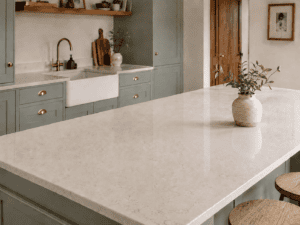 Quartz has become the default “if I could have anything” worktop for Irish kitchens, and in a lot of cases it’s the right call — it’s harder-wearing than laminate, more consistent than natural granite, and available in colours that didn’t exist even five years ago. It’s also one of the easiest kitchen decisions to overspend on without realising it, because the price gap between a perfectly good quartz colour and a showroom-favourite premium slab can be enormous for a result that looks almost identical once it’s fitted. This guide walks through real 2026 Irish pricing, which colours are actually worth paying more for, and what separates a good quartz installation from a mediocre one.
Contents
- What quartz worktop actually means
- Quartz worktop prices in Ireland (2026)
- Quartz colours worth choosing — and ones to think twice about
- Quartz vs granite vs laminate
- How to buy quartz without overpaying
- Caring for a quartz worktop
- FAQ
What quartz worktop actually means
Quartz worktops are engineered stone: roughly 90-94% crushed natural quartz mineral bound with resin and pigment, pressed into a solid slab. That engineering is exactly why quartz behaves more predictably than granite — colour and pattern are consistent across a whole slab and between slabs from the same batch, which granite, as a purely natural material, can’t guarantee. Standard thicknesses fitted in Irish kitchens are 20mm and 30mm, with 20mm now the more common choice on a build-up (doubled) edge to give the appearance of a thicker, more substantial worktop without the cost of a full 30mm slab throughout.
| Brand / range | Positioning | Typical price band |
|---|---|---|
| Entry-level engineered quartz (unbranded or house range) | Solid colours, limited pattern range | €300 – €420 per m² fitted |
| Mid-range branded quartz (e.g. Silestone core collection) | Broader colour range, consistent veining options | €420 – €580 per m² fitted |
| Premium branded quartz (e.g. Silestone/Caesarstone premium ranges) | Large-format veined slabs, book-matched patterns | €580 – €800+ per m² fitted |
Quartz worktop prices in Ireland (2026)
For an average Irish kitchen worktop run of around 5-6 linear metres (roughly 5-7m² once you include the return legs and any island), a fully fitted quartz worktop in 2026 typically comes to somewhere between €2,000 and €4,500 for a good mid-range branded quartz, rising well past €5,000 for a premium veined slab on a larger island. That’s a significant jump from laminate, and it’s worth reading it alongside our worktop pricing guide so the quartz decision sits inside your overall kitchen budget rather than being priced in isolation.
A few cost drivers that catch people out: a mitred waterfall edge down the side of an island can add 1.5-2 linear metres of “extra” worktop to the quote even though it’s the same piece of stone wrapped around; an undermount sink cut-out with a polished edge costs more than a standard drop-in sink cut; and matched-pattern veining across a seam (rather than a random join) is a specified, chargeable extra at most fabricators, not something included by default.
See quartz worktop options at our showroom →
Quartz colours worth choosing — and ones to think twice about
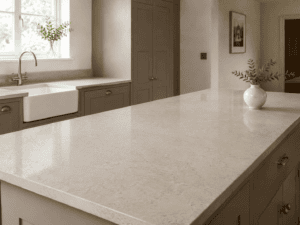
- Warm white and off-white with subtle grey veining continues to be the best-selling category across Dublin kitchens, largely because it works with almost any cabinet colour and doesn’t compete with the rest of the room.
- Calacatta and Carrara-style veined whites look striking on a showroom sample but are worth seeing in a full slab or large-format sample before committing — the vein pattern repeats more obviously than people expect on a long, unbroken run.
- Warm greige and taupe tones have grown quickly over the last year, particularly paired with warm oak cabinetry rather than cool grey.
- Dark, near-black quartz makes a strong statement on an island but shows water spots, dust and light scratching far more visibly than lighter colours — worth being honest with yourself about how often the household actually wipes down a worktop before choosing it.
- Concrete-effect and terrazzo-effect quartz is a genuine current trend, particularly in slab and handleless kitchens, though it’s a bolder choice that’s harder to resell a house around than a neutral stone-effect.
If you’re still deciding on the overall kitchen style before settling on a worktop colour, our Shaker vs modern kitchen guide and the kitchen cabinets guide are worth reading first — the worktop should follow the cabinet decision, not lead it.
Quartz vs granite vs laminate
| Laminate | Granite | Quartz | |
|---|---|---|---|
| Typical price (fitted, per m²) | €150 – €260 | €280 – €500 | €300 – €800+ |
| Consistency of colour/pattern | Fully consistent (printed) | Varies slab to slab | Very consistent |
| Heat resistance | Poor — always use a trivet | Very good | Good, but not heatproof at direct contact |
| Scratch resistance | Fair | Very good | Very good |
| Best suited to | Budget-conscious full refits | Homeowners wanting a natural, one-of-a-kind slab | Households wanting durability and colour consistency |
For the full comparison across every worktop material, not just these three, see our kitchen worktop materials guide.
How to buy quartz without overpaying
See a full slab, not a hand sample
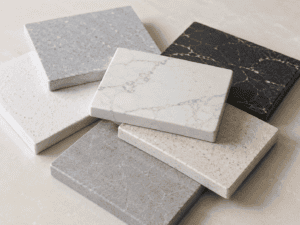
A 10cm sample can look almost identical for three colours that behave very differently across a 3-metre run. Ask to see a full slab, or at minimum a large-format sample, before signing off, particularly for anything with visible veining.
Ask what’s included in the “per metre” price
Get the sink cut-out, hob cut-out, upstand, and any waterfall or mitred edge itemised separately. A quote that only shows one number per linear metre is the most common way homeowners end up with a final invoice well above what they expected.
Check the seam plan before installation day
On any run longer than a single slab (roughly 3.2m for most quartz ranges), ask exactly where the seam will fall and whether pattern-matching is included. This should be marked on a template drawing before the stone is cut, not decided on the day of fitting.
The most expensive quartz mistake we see isn’t the slab itself, it’s homeowners choosing a heavily veined premium colour without ever seeing more than a small sample, then being disappointed when the seam or the repeat pattern shows up somewhere they didn’t expect. A mid-range quartz seen as a full slab beats a premium quartz chosen from a swatch, every time.
Caring for a quartz worktop
Quartz is low-maintenance but not maintenance-free. Wipe spills promptly, particularly acidic ones like wine, vinegar or citrus, which can dull the resin finish over time if left to sit. Avoid direct contact with a hot pan straight from the hob — quartz handles heat better than laminate but resin-bound stone can still discolour or crack under sudden thermal shock. Strong bleach and abrasive scourers are best avoided in favour of a standard non-abrasive kitchen cleaner.
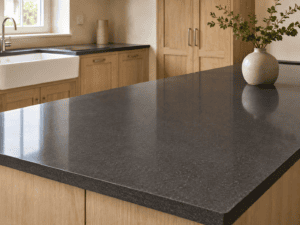
Is quartz the right choice for your kitchen?
If durability, colour consistency and long-term resale appeal matter more to you than upfront cost, quartz remains the strongest all-round choice on the Irish market in 2026. The households who end up happiest with it are the ones who chose a colour they’d seen in full slab form, got the cut-outs and edge details itemised on the quote, and picked a mid-range range rather than assuming premium always means better for their particular kitchen.
See quartz worktops fitted in real Dublin kitchens in our kitchen projects gallery, or book a free design consultation and we’ll bring genuine full-size slab samples to your home.
Frequently Asked Questions
Is quartz worth the extra cost over laminate?
For most households planning to stay in the home long-term, yes — the durability and resale appeal generally justify the difference, though a well-fitted laminate is a perfectly sound choice on a tighter budget.
Can quartz crack or chip?
It’s more resistant to chipping than granite in most cases, but a sharp impact on an unsupported overhang or edge can still crack it, so overhangs beyond about 300mm should be supported with brackets.
Is quartz heatproof?
It’s heat-resistant, not heatproof — always use a trivet or board for pans straight off the hob, since sudden extreme heat can still damage the resin binder.
How thick should a quartz worktop be?
20mm with a doubled build-up edge is the most common choice in Irish kitchens today, giving the visual weight of a thicker slab at a lower material cost than a full 30mm worktop.
Does quartz need to be sealed?
No — unlike granite or marble, quartz is non-porous and doesn’t require sealing, which is one of its main practical advantages.
What’s the difference between quartz and granite?
Granite is a fully natural stone with colour and pattern that vary slab to slab; quartz is engineered from crushed quartz and resin, giving far more consistent colour and pattern across the whole worktop.
Can I get a seamless quartz island?
On smaller islands, yes, within a single slab’s maximum length; on longer islands a seam is usually unavoidable and should be planned and pattern-matched at the design stage.
How long does quartz installation take?
Templating typically happens after cabinets are fitted, with the stone cut and fitted roughly one to two weeks later, so it’s worth factoring into the overall renovation timeline discussed in our kitchen renovation cost guide.
Related Kitchen Projects & Guides
- Laminate Kitchen Worktops in Ireland: Prices, Colours & What to Know
- Kitchen Worktop Prices Ireland 2026
- Kitchen Worktop Materials Compared
- Kitchen Renovation Clontarf, Dublin — Sage Green Shaker Island
Considering quartz for your own kitchen? Book a free design consultation and we’ll bring real full-size quartz slab samples for you to see against your cabinet and floor colours.