Dublin Kitchens

Laminate Kitchen Worktops in Ireland: Prices, Best Colours & What to Know Before You Buy (2026)
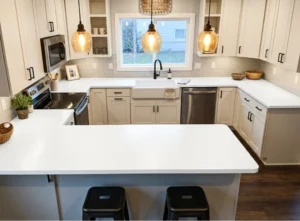
If you’ve started pricing a new kitchen or a worktop replacement, laminate is very likely the material you keep coming back to. It’s still the worktop fitted into more Irish kitchens than any other, not because it’s the cheapest option on the shelf, but because for most households it does the job well without asking them to plan their whole kitchen around a single slab of stone. This guide sets out what laminate worktops actually cost in Ireland right now, which colours and finishes are holding up in real use, and the handful of details that decide whether a laminate worktop looks sharp in five years or starts to look tired within eighteen months.
Contents
- What a laminate worktop actually is
- Laminate worktop prices in Ireland (2026)
- Best laminate worktop colours and finishes
- Where laminate works well, and where it doesn’t
- Four things to check before you order
- Looking after a laminate worktop
- FAQ
What a laminate worktop actually is
A laminate worktop is a chipboard or MDF core faced with a thin decorative laminate layer, usually finished with a “postformed” front edge — that’s the smooth, rolled-over lip you’ll recognise on most Irish kitchen worktops rather than a hard square edge. Standard thickness is 38mm, and the decorative surface is what gives you the colour and texture: matte stone effects, woodgrains, solid colours and gloss finishes are all produced the same way, just with a different printed or textured layer on top.
It’s worth being clear about this early, because “laminate” gets used loosely. It is not the same product as a solid laminate (Formica-style) worktop bonded to a substrate on site, and it’s a different manufacturing process again from quartz or granite, which are solid mineral slabs right through. None of that makes laminate a lesser choice — it’s simply a different way of getting a durable, good-looking surface, at a price point that keeps the rest of the kitchen budget intact.
Laminate worktop prices in Ireland (2026)
Pricing depends on run length, edge profile, and whether you’re buying supply-only or supply-and-fit, but here’s a realistic 2026 range for a standard 38mm postformed laminate worktop in an Irish kitchen:
| Worktop type | Typical price per linear metre (supply only) | Typical price per linear metre (supplied & fitted) |
|---|---|---|
| Standard solid-colour laminate, 38mm | €60 – €95 | €110 – €160 |
| Stone-effect or marble-effect laminate, 38mm | €85 – €130 | €140 – €200 |
| Woodgrain / oak-effect laminate, 38mm | €90 – €135 | €145 – €205 |
| Premium matte/textured laminate (e.g. Egger Feelwood or similar ranges), 38mm | €110 – €160 | €165 – €230 |
For an average Irish kitchen with roughly 5-6 linear metres of worktop, that puts a fully fitted laminate worktop somewhere between about €700 and €1,400 for standard finishes, or €900-€1,400 for the premium matte and woodgrain ranges. Corner joints, an upstand along the wall, and a drainer groove cut into the worktop next to the sink will all add a modest amount on top — ask for these to be itemised rather than folded into a single “worktop” line, so you can see what you’re actually paying for.
For a full breakdown of how worktop cost fits into the rest of a kitchen budget, our Kitchen Cost Guide and our dedicated worktop pricing guide cover the wider picture, including quartz, solid wood and laminate side by side.
Best laminate worktop colours and finishes
What’s actually selling in Dublin kitchens right now has shifted noticeably over the past couple of years. A few patterns worth knowing before you start narrowing down samples:
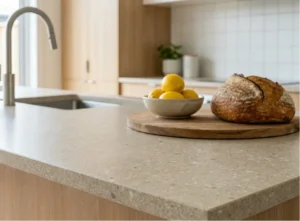
- Light grey and warm grey stone-effects remain the safest, best-selling choice — they read as neutral against almost any cabinet colour and don’t date the way a strongly veined marble-effect can.
- Matte, low-sheen finishes (rather than the older high-gloss laminate surfaces) are what most homeowners are choosing now. They hide fingerprints and light scratching far better than gloss, and they photograph better under kitchen spotlights too.
- Warm oak and mid-tone woodgrains are the strongest-growing category, usually paired with a Shaker or handleless door in a dark or muted colour — sage, graphite, navy — to give contrast.
- Dark, near-black stone-effects still suit contemporary slab or handleless kitchens but show water marks and dust more readily than lighter tones, so they’re a better fit for households who wipe down worktops daily than for very busy family kitchens.
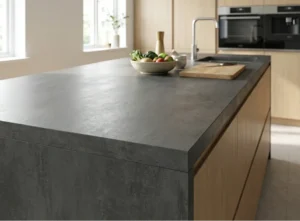
- Concrete-effect laminate has moved from a niche choice into the mainstream over the last year, particularly in gloss or matt modern slab kitchens.
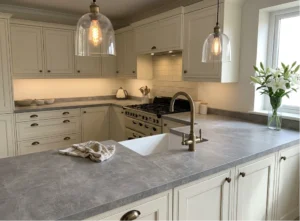
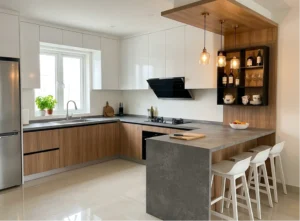
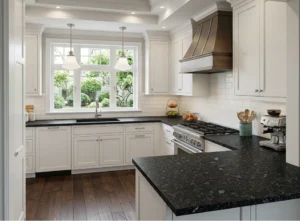
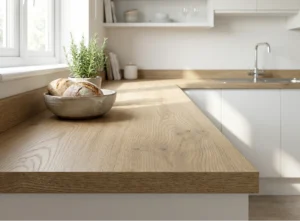
If you’re weighing up colour against the rest of the kitchen rather than the worktop in isolation, our kitchen cabinets guide and the Shaker vs modern kitchen comparison are worth reading alongside this one, since worktop and door finish decisions really need to be made together, not worktop first and door as an afterthought.
Where laminate works well, and where it doesn’t
The genuine advantages
- Lowest cost per linear metre of any worktop material that still looks like a proper fitted surface, not a stopgap.
- Wide colour and finish range, including very convincing stone and wood effects at a fraction of the price of the real material.
- Warmer underfoot and to the touch than stone — a small thing, but noticeable if you lean on the worktop a lot.
- Straightforward to replace later if you renovate again, without the structural planning a heavy stone slab requires.
Where it’s genuinely the wrong choice
- Direct heat from a pan straight off the hob will scorch or bubble the laminate surface — always use a trivet or board, no exceptions.
- It’s not as scratch-resistant as quartz or granite, so a dedicated chopping board matters more here than with a stone worktop.
- The seam where two lengths join, and the join at an internal corner, is the one place laminate can let you down if it’s not fitted tightly — more on that below.
- It’s not a good fit for households set on a large single-slab waterfall island edge, since laminate reads as a “worktop” rather than a “surface” at that scale.
Our fitters see the same failure point again and again on laminate worktops that were done badly: it’s almost never the laminate material itself, it’s a loose corner joint or an unsealed cut edge around the sink or hob cut-out that lets moisture in over time. Get those two details right and a laminate worktop will comfortably outlast the kitchen it’s fitted into.
Four things to check before you order
1. Ask which core board is being used
Moisture-resistant (green) chipboard core around the sink and hob run is worth asking for specifically, particularly in smaller kitchens where the sink sits close to a corner joint.
2. Get the edge profile confirmed in writing
Postformed (rolled) edges are standard and the most water-resistant option since there’s no exposed seam along the front. Square-edge laminate looks sharper in some contemporary kitchens but needs an edging strip that should be specified up front, not decided on site.
3. Check how the corner joint will be made
A router-cut, bolted mitre joint pulled tight with worktop bolts is the standard for a good fit. Ask your installer directly how they join laminate at internal corners — it’s a fair question and any experienced fitter will answer it without hesitation.
4. Confirm the drainer and hob cut-outs are sealed, not just cut
Every cut edge in a laminate worktop needs to be sealed with a proper edging strip or silicone seal before the sink or hob goes in. This is a five-minute job that gets skipped far too often, and it’s the single biggest cause of laminate worktops swelling at the sink cut-out within a year or two.
Looking after a laminate worktop
Day to day, laminate needs very little: wipe with a damp cloth and a mild washing-up liquid, avoid abrasive scourers on gloss finishes, and re-seal the joint strip and any hairline gaps at the wall with silicone if you notice one opening up. Standing water left pooled against the upstand overnight is worth avoiding on any worktop, laminate included — it’s a slow, cumulative risk rather than a one-off problem, but it’s also entirely avoidable with a quick wipe before bed.
Getting it right for your kitchen
Laminate worktops earn their popularity honestly — for the vast majority of Irish kitchens, a well-specified, well-fitted laminate worktop in a matte stone or warm woodgrain finish will do everything a family needs for a decade or more, at a price that leaves room in the budget for better cabinets, better appliances, or both. Where it falls down is almost always in the fitting, not the material, which is exactly why the joint, the seal and the core board matter more than the colour swatch.
If you’d like to see laminate worktops specified against real cabinet colours and layouts, our kitchen projects gallery includes several recent fits, and our design team can talk you through samples and pricing for your own kitchen at a free design consultation.
Frequently Asked Questions
Is laminate a good worktop for a family kitchen?
Yes, for most families it’s a sensible middle ground — durable enough for daily use, warm underfoot, and inexpensive enough to replace without major disruption if it does eventually wear.
How long does a laminate worktop actually last?
With a properly sealed joint and cut-outs, ten to fifteen years of daily use is realistic before a homeowner would choose to replace it, usually for a style refresh rather than because the worktop has failed.
Can you repair a chip or burn in a laminate worktop?
Small chips can be filled and colour-matched reasonably well; a deep burn or scorch mark usually can’t be fully hidden and the affected section is better replaced.
Is laminate cheaper than quartz in Ireland?
Yes, typically by roughly half to two-thirds per linear metre, though the exact gap depends on the quartz colour and edge detail chosen — see our worktop pricing guide for a full side-by-side.
Does laminate look cheap next to a Shaker kitchen?
Not if the finish is chosen carefully — a matte stone-effect or warm woodgrain laminate reads as a considered, tonal choice against a Shaker door, particularly with a slim postformed edge rather than a bulky one.
What thickness of laminate worktop is standard in Ireland?
38mm is standard for postformed laminate worktops fitted in Irish kitchens; thinner 28-30mm boards exist but are less common outside budget fit-outs.
Can laminate worktops be fitted around an island?
Yes, though a visible corner or straight joint is usually needed on longer island runs, whereas quartz can sometimes achieve this in one piece — worth discussing at design stage if a completely seamless island top matters to you.
Do laminate worktops need to be sealed like wood or stone?
No ongoing sealing is needed on the surface itself, but the cut edges around the sink and hob should be checked periodically to make sure the original seal hasn’t opened up.
Related Kitchen Projects & Guides
- Kitchen Worktop Prices Ireland 2026
- Kitchen Worktop Materials Compared
- Kitchen Cabinets Ireland: 2026 Guide to Styles, Materials & Costs
- Light Grey Shaker L-Shaped Kitchen in Rathmines, Dublin
Thinking about a laminate worktop for your own kitchen? Book a free design consultation with our team and we’ll bring real laminate samples to your home, matched against your cabinet and floor colours.