Dublin Kitchens

Kitchen Splashback Ideas & Materials: A Complete Guide for Irish Kitchens
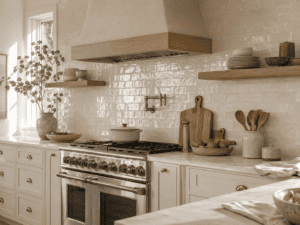
The splashback tends to get decided in the last few weeks of a kitchen project, often as an afterthought once the cabinets, worktop and appliances are already chosen. That’s understandable, but it’s also how a lot of people end up with a splashback that doesn’t quite work with everything else in the room. This guide covers the main splashback materials available to Irish homeowners, realistic costs, and how to choose one that finishes the kitchen properly rather than sitting slightly apart from it.
Contents
- Splashback materials compared
- Splashback vs upstand — do you need both?
- Choosing a splashback that works with your worktop
- What a splashback costs in Ireland
- Practical details worth getting right
- FAQ
Splashback materials compared
| Material | Look | Maintenance | Typical cost |
|---|---|---|---|
| Painted or coloured glass | Seamless, modern, wide colour range | Very easy to wipe clean, no grout lines | €250 – €500 per m², fitted |
| Metro or ceramic tile | Classic, textured, works in Shaker kitchens especially | Grout needs occasional cleaning/resealing | €120 – €280 per m², fitted |
| Stone-effect laminate or acrylic panel | Matches a laminate worktop closely, seamless join possible | Easy wipe-clean, avoid abrasive scourers | €150 – €320 per m², fitted |
| Matching quartz upstand/panel | Fully seamless with a quartz worktop | Very low maintenance, non-porous | €300 – €600 per m², fitted |
| Stainless steel | Industrial, professional-kitchen look | Shows fingerprints, easy to wipe | €200 – €400 per m², fitted |
For the worktop materials referenced in this table, see our full laminate worktop guide and quartz worktop guide.
Splashback vs upstand — do you need both?
An upstand is the short (typically 100mm) strip that sits along the back edge of the worktop against the wall, usually made from the same material as the worktop itself. A splashback is the larger panel, usually behind the hob and sometimes the sink, that protects the wall from splashes and heat. Most Irish kitchens use both: an upstand along the full length of the worktop for a neat, gap-free finish, and a dedicated splashback material behind the hob specifically, where heat and grease splashing are the real practical concern.
- Upstand only, no dedicated splashback: acceptable behind runs with no hob, but not recommended directly behind a hob.
- Splashback behind the hob only: the minimum sensible specification for any kitchen.
- Full-height splashback behind the whole worktop run: the most complete finish, and the easiest to keep genuinely clean, but the highest cost.
Choosing a splashback that works with your worktop
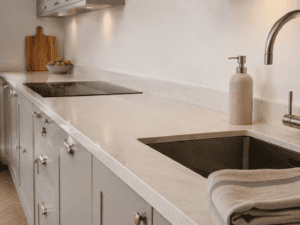
The safest, most durable-looking kitchens tend to follow one of two rules: either the splashback closely matches the worktop material and colour for a continuous, seamless look, or it deliberately contrasts as a feature in its own right, most commonly with a metro tile or a bold coloured glass panel. What tends not to work as well is a splashback that’s simply “close enough” to the worktop colour without actually matching or clearly contrasting — it reads as a mismatch rather than a decision.
If you’ve already chosen your worktop colour using our worktop colours guide, matching or deliberately contrasting the splashback against that same colour is the right next step, rather than choosing the splashback in isolation.
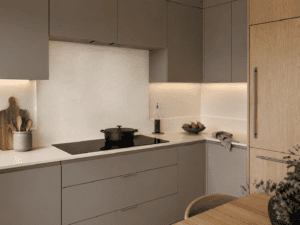
The splashback question we get most often is whether to match the worktop or the cabinets. Our answer is almost always: match the worktop behind the hob for practicality and a clean line, and use tile or colour as a feature anywhere it isn’t taking direct heat or grease, like behind an open shelf run.
What a splashback costs in Ireland
For a standard hob-width splashback (roughly 900mm-1,200mm wide, 600mm high), most Irish households spend between €150 and €500 depending on material, with glass and matching-quartz options at the upper end. A full-height splashback along an entire worktop run of 4-5 linear metres typically runs from €600 up to €2,000+ for a premium glass or matching stone finish. These figures sit outside the core cabinet and worktop costs covered in our Kitchen Cost Guide, so it’s worth budgeting for the splashback separately rather than assuming it’s included in a worktop quote.
Practical details worth getting right
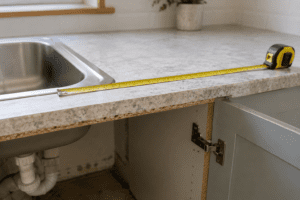
- Measure after the worktop is templated, not before — a glass or stone splashback needs to be cut to the actual finished worktop line, not the plan drawing.
- Check socket cut-outs are planned — any splashback behind a run with sockets needs precise cut-outs, which should be confirmed before the panel is ordered, not discovered on fitting day.
- Ask about heat rating behind the hob — not every glass or acrylic product is rated for direct heat exposure; confirm this specifically for the section directly behind the hob.
- Grout colour matters as much as tile colour for tiled splashbacks — a dark grout with a white metro tile reads very differently to a white grout with the same tile.
Finishing the kitchen properly
A splashback is a small area of the kitchen in square metres, but it sits directly at eye level behind the hob and worktop, which makes it more visually prominent than its size suggests. Choosing it deliberately — matched or clearly contrasted, planned before the worktop is templated, and specified for the right heat and maintenance needs — is what separates a kitchen that looks fully finished from one that looks like the splashback was an afterthought, because too often, it was.
See splashback choices in real Dublin kitchens in our kitchen projects gallery, or book a free design consultation and we’ll help you choose a splashback alongside your worktop and cabinet colours, not after them.
Frequently Asked Questions
Do I need a splashback if I have an upstand?
An upstand alone is fine along most of the worktop, but a dedicated splashback material is strongly recommended directly behind the hob, where heat and grease splashing are a real practical concern.
What’s the most low-maintenance splashback material?
Glass and matching quartz panels are the easiest to keep clean since they have no grout lines to maintain, unlike tiled splashbacks.
Can I match my splashback to my worktop exactly?
Yes — a matching quartz or stone-effect laminate panel behind the worktop gives the most seamless, continuous look, particularly effective on a hob wall.
How much does a glass splashback cost in Ireland?
Typically €250-€500 per m² fitted, depending on colour and whether it’s a standard toughened glass panel or a bespoke printed design.
When should I choose my splashback in the renovation process?
Ideally at the same time as your worktop and cabinet colours, and it should be measured for after the worktop is templated, since it needs to be cut to the actual finished worktop line.
Are tile splashbacks still a good choice in 2026?
Yes, particularly metro tiles in Shaker-style kitchens — they remain a classic, cost-effective choice, though they need slightly more maintenance around the grout lines than glass or stone options.
Related Kitchen Projects & Guides
- Best Kitchen Worktop Colours in Ireland for 2026
- Quartz Kitchen Worktops in Ireland: Prices, Colours & Buying Guide
- Kitchen Cost Guide Ireland
- White U-Shaped Kitchen Renovation in Ranelagh, Dublin
Finishing your kitchen and not sure about the splashback? Book a free design consultation and we’ll help you choose one that works with the rest of your kitchen.